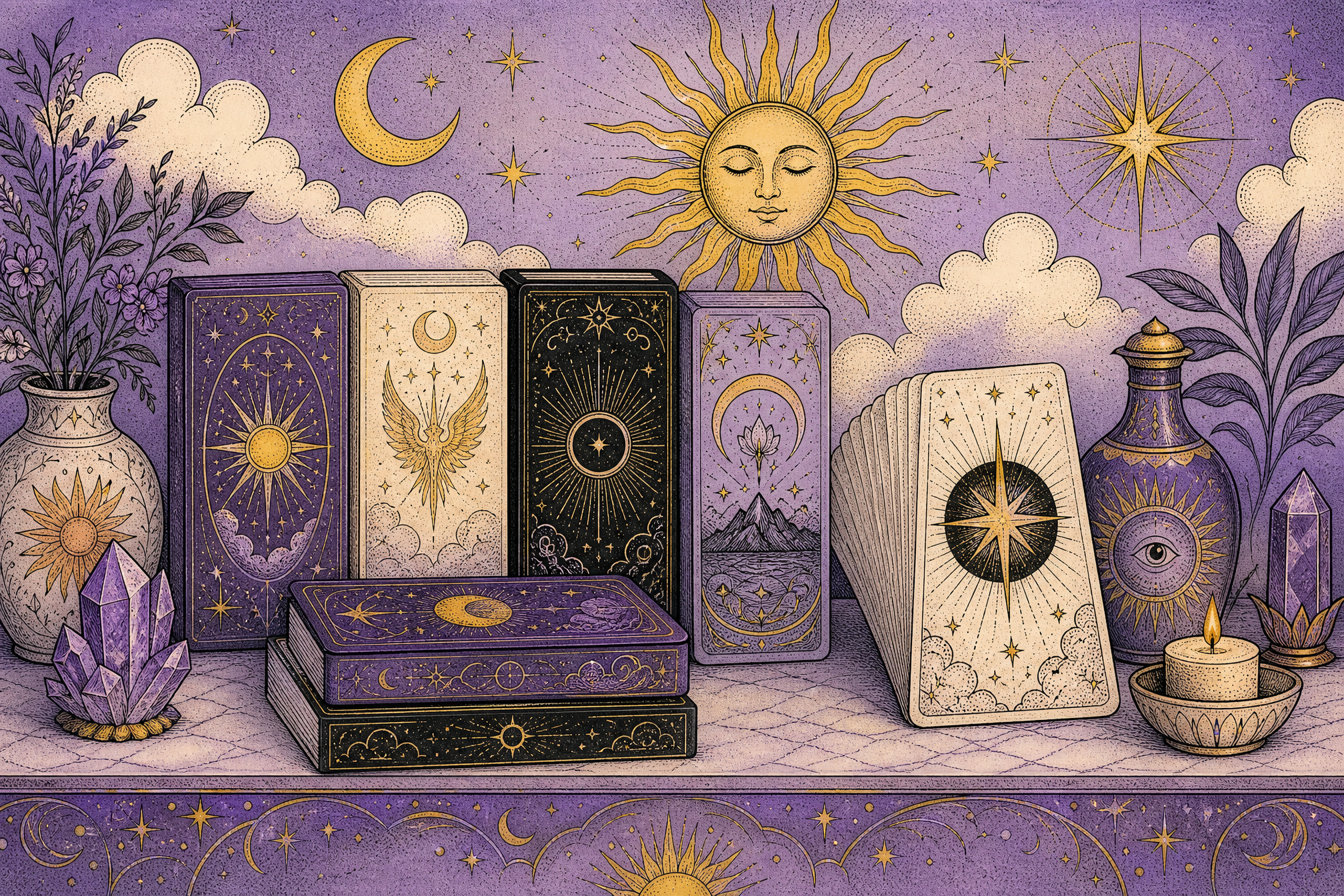
- For a first deck the answer is almost always the same: Rider-Waite-Smith, the common language of tarot.
- Check that you are buying a full 78-card tarot deck and not an oracle deck, which has no fixed structure.
- The Osho Zen Tarot is a separate 79-card system. Excellent for reflection, awkward for learning tarot.
- A standard Rider-Waite-Smith deck runs roughly $15 to $25. Collector editions cost more and teach you nothing extra.
- You do not need a deck to start. Learning the cards and practicing online costs nothing at all.
Why Rider-Waite-Smith Is the Best Tarot Deck for Beginners
If you are starting out, the answer is almost boringly consistent: buy a Rider-Waite-Smith deck, first published in 1909 and illustrated by Pamela Colman Smith. Not because it is the most powerful deck, since no deck is, but because it became the common language of tarot. Nearly every book, course, class, and site you will ever learn from, including the Lunara card index, is built on its imagery. Everything you read will match the deck in your hands. That sounds like a small convenience and it is not.
Its real advantage is the Minor Arcana. In Rider-Waite-Smith, all 56 Minor cards are drawn as complete scenes rather than arrangements of symbols. The Three of Swords is a heart pierced by three blades under a grey rain, and you can take something from it before you have read a single word about it. In an older pip-style deck the same card is three swords on a bare ground, and it tells you nothing until you have memorized what it is supposed to mean. For a beginner, that difference is worth about a year.
There is a second, quieter reason. Because so much of the world learned on this deck, its images are what most people mean when they picture a tarot card. When you eventually read for a friend, they will recognize what they are looking at, and that recognition does half the work of the conversation.
The Four Main Tarot Deck Styles
- Rider-Waite-Smith — the modern standard. Illustrated, approachable, and documented to death. The safe choice, and the right one for a first deck.
- Tarot de Marseille — the older European tradition, roughly seventeenth and eighteenth century. Its Minor Arcana are geometric pip cards rather than scenes. Genuinely beautiful and historically serious, and considerably harder to learn on.
- Thoth — designed by Aleister Crowley and painted by Lady Frieda Harris, layered with Kabbalah, astrology, and a very deliberate color system. Rich and rewarding, and best approached once you already have a system in your head.
- Osho Zen — a modern deck in an Eastern register, aimed squarely at the present moment rather than the future. Lovely for reflection, and structurally not classical tarot. More on that below.
Tarot Deck Comparison Chart
| Deck | Cards | Who it suits | Difficulty |
|---|---|---|---|
| Rider-Waite-Smith | 78 | Beginners, and anyone who wants to learn properly | Easy |
| Tarot de Marseille | 78 | Lovers of the old European tradition | Medium to hard |
| Thoth | 78 | Experienced readers who enjoy symbolic layers | Hard |
| Osho Zen | 79 | Present-moment reflection, not tarot study | Easy |
| Oracle / angel decks | Varies | An encouraging daily pull | Very easy |
Have a question of your own? The cards are open.
Is the Osho Zen Tarot a Real Tarot Deck?
It is a real deck and a good one. It is not, strictly speaking, a tarot deck, and the confusion is common enough to be worth clearing up before you spend money.
The Osho Zen Tarot holds 79 cards, not 78. The names are largely its own: where classical tarot has Death, this deck has Transformation. The structure does not map cleanly onto the traditional Major and Minor Arcana, and the stated focus is the present moment rather than any claim about the future. In that sense it sits much closer to therapeutic card work than to predictive tarot.
Who it suits: anyone put off by the mystical baggage around tarot, anyone who wants observation instead of forecast, and anyone drawn to clean modern art. Who it does not suit: anyone who wants to learn classical tarot. The meanings and the architecture are different, and almost no teaching material in the world is written for it, so you will find yourself learning a system that is hard to continue from.
Are Oracle Cards and Angel Cards Tarot?
No, and the shelf they sit on rarely makes that clear. Angel cards, message cards, and every other oracle deck have no fixed structure. The card count changes from deck to deck, each one speaks its own private language, and most of them print the message directly on the card so there is nothing left to interpret.
That is not worse. It is a different tool. An oracle hands you a message; tarot hands you a system. If you want to learn to read in depth, start with tarot, where the same 78 cards behave consistently and a spread has a grammar you can learn. If you want a kind sentence with your coffee and no study whatsoever, an angel deck delivers exactly that. There is no rule against keeping both in the same drawer.
What to Check Before You Buy
- A full 78-card deck. Confirm the listing says 78. If the count is anything else, you are looking at an oracle deck or a variant system, not standard tarot. Our guide to how many cards a tarot deck holds explains what those 78 are made of.
- Card stock. You will shuffle these constantly. Thick, coated stock with a smooth finish survives years of handling; thin uncoated card starts curling and sticking within months.
- Size. Giant and pocket editions exist and both look charming online. For average hands, the standard size is far easier to shuffle properly, which matters more than you would expect.
- The guidebook. Most decks ship with a small booklet. Pleasant to have, not remotely essential, and never a reason to pay extra.
- The edition. Rider-Waite-Smith exists in dozens of legitimate printings, plus a fair number of low-quality knockoffs with muddy color. Buy from a real publisher or a reputable seller and you will avoid the bad ones.
How Much Does a Tarot Deck Cost, and Where to Buy One
A standard Rider-Waite-Smith deck generally runs about $15 to $25, depending on the edition and the seller. Sets bundled with a full book, the Osho Zen Tarot among them, tend to sit nearer $25 to $35, because you are also paying for a book. Collector printings, gilded edges, oversized art editions, and limited runs climb well past that, and none of them will make you a better reader.
Where to look, roughly in order of selection:
- Online retailers. The widest range and usually the best price. Publishers often sell direct as well, which is the surest way to get a genuine printing.
- Metaphysical and new age shops. The best place to actually handle a deck before buying, and the staff have generally read from half the stock.
- General bookshops. Many keep a small tarot shelf in the mind-body section, usually stocking the classics rather than anything unusual.
- Game and hobby shops. Hit and miss, but they occasionally carry mainstream decks at ordinary prices.
One tip for a first purchase: skip the beautiful expensive edition. A basic Rider-Waite-Smith deck will serve you perfectly, and the money is better spent later, once you know which art actually speaks to you.
Should You Buy a Used Tarot Deck?
Second-hand decks turn up constantly on resale sites and in used bookshops, often at half price, and practically there is nothing wrong with that. Check two things. First, that the deck is complete — ask the seller to count it, because a deck missing one card is worth nothing. Second, that the cards are not faded, warped, or tacky from years of handling.
Some readers prefer a new deck rather than one carrying, as they put it, someone else's energy. That is a completely legitimate preference and there is no rule either way. If the thought bothers you, buy new; it costs a few dollars more and settles the question.
Does a Tarot Deck Have to Be a Gift?
No. The old rule that you must never buy your own deck and should wait to receive one has no traceable source. It appears to have drifted out of family stories and mid-century magazine advice and then hardened into folklore, which is what folklore does.
Reading tarot well depends on knowing the cards and asking honest questions. It does not depend on the transaction history of the cardboard. If you have been waiting for a gift that never arrived, go buy the deck.
How to Take Care of a Tarot Deck
Many questions, very few actual rules. Practically, what matters is that the cards stay dry and their edges stay intact. The original box or a cloth bag does the job; silk is traditional and entirely optional. A deck in daily use will last years.
Then there are the customs: wrapping the deck in cloth, storing it in a wooden box, resting a stone on top, keeping it in one fixed place, cleansing it periodically. These are personal practices rather than requirements, and none of them will change the quality of your readings. If they help you treat the cards with a little ceremony, that is reason enough to keep them.
You Don't Need a Deck to Start
Here is the small truth that a buyer's guide is not supposed to end on: you do not need a deck to begin. You can meet the cards, learn to read them, and practice for weeks without spending anything. Most people who buy a deck on day one leave it in the box, simply because 78 cards is a great many cards to face at once.
A free daily card is the best way to find out whether the cards actually speak to you, one card at a time. Browse the Lunara deck to see what a full set looks like, and when you notice you recognize half of it without checking the meaning, that is the moment to go and buy one. By then you will also know which style you want. And if you are still working out what this whole thing is, start here instead.