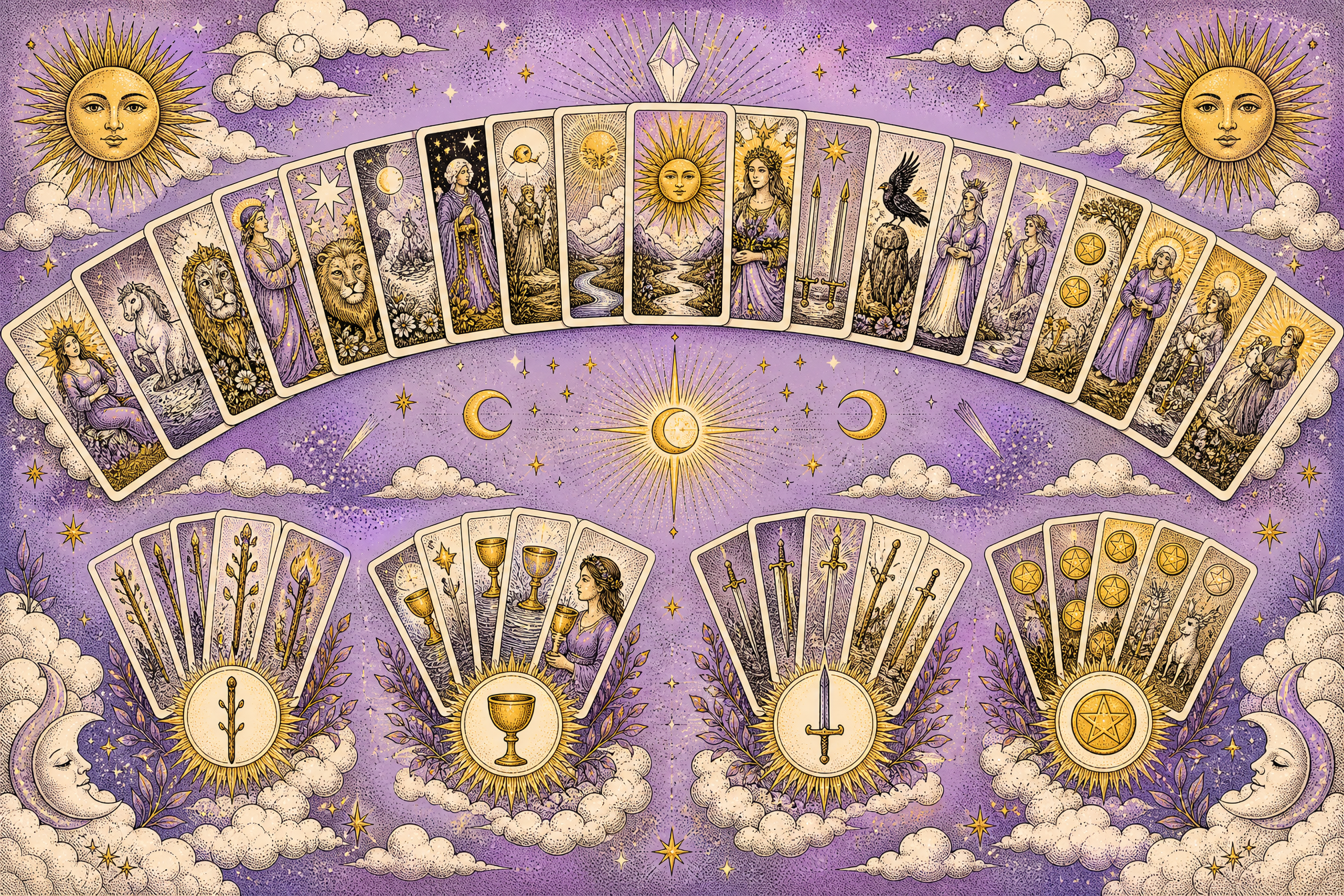
- A full tarot deck has 78 cards, and that count is the same in almost every modern deck.
- 22 of them are the Major Arcana, numbered 0 (The Fool) through 21 (The World).
- The other 56 are the Minor Arcana, split into four suits of 14 cards each.
- The suits are Cups, Pentacles, Swords, and Wands: 10 numbered cards plus 4 court cards apiece.
- 16 of the 78 are court cards, a Page, Knight, Queen, and King in every suit.
- A 52-card playing deck is the same skeleton minus the 22 Majors and the four Knights.
How Many Cards Are in a Tarot Deck?
A standard tarot deck contains 78 cards. Those 78 split cleanly in two: 22 Major Arcana cards and 56 Minor Arcana cards. Nearly every deck sold today follows this count exactly, from the Rider-Waite-Smith deck to the Thoth deck to the hundreds of independent decks published every year.
The arithmetic, in one line: 22 Majors + (4 suits × 14 cards) = 22 + 56 = 78.
The number is neither arbitrary nor mystical. It fell out of a fifteenth-century Italian card game, and the symbolic meaning was attached centuries afterward. That history explains the structure better than any numerological reading of 78 ever has, and we get to it further down.
The 22 Major Arcana Cards
The Major Arcana is 22 cards, numbered 0 through 21. It opens with The Fool at 0 and closes with The World at 21, and the cards between them trace what readers call the Fool's Journey: a life moving from raw beginning to completion.
These are the cards everyone can name. Death, The Lovers, The Tower. They deal in the structural stuff of a life, change and choice and crisis and revelation, and when several show up in one spread you are usually looking at a chapter rather than a Tuesday. The complete list in order, with what each one means, is in our guide to the 22 Major Arcana.
One quirk worth knowing before you start counting: The Fool is numbered 0 in most decks and left unnumbered in a few. Either way it is one of the 22.
The 56 Minor Arcana Cards
The remaining 56 cards are the Minor Arcana, and this is where most of an actual reading lives. They handle the everyday: the job, the argument, the money question, the small decision you keep postponing. A spread made mostly of Minors is not a weak spread, it is a spread about your real life.
The 56 divide into four suits of 14 cards each, and every suit is built to the identical pattern. That repetition is the single most useful fact in learning tarot: it turns 56 separate cards into a grid you can reason your way around instead of a list you have to memorize.
Have a question of your own? The cards are open.
The Four Tarot Suits and How Many Cards Each Has
Each suit holds 14 cards and owns one element and one department of life:
- Cups (Water), 14 cards covering emotion, love, and connection, the things you feel.
- Pentacles (Earth), 14 cards covering money, work, the body, the things you can touch.
- Swords (Air), 14 cards covering thought, truth, conflict, the things that get said.
- Wands (Fire), 14 cards covering drive, creativity, and initiative, the things you do.
Suit names drift between decks without the count ever changing. Pentacles turn up as Coins or Disks, Wands as Staves, Rods, or Batons. Same suit, same 14 cards, different word on the box. Our guide to choosing a deck goes through which naming conventions belong to which lineage.
The Full 78-Card Breakdown
The whole deck, group by group:
| Group | Cards | What is in it |
|---|---|---|
| Major Arcana | 22 | Numbered 0 through 21, The Fool to The World |
| Cups | 14 | Ace through Ten, plus 4 court cards |
| Pentacles | 14 | Ace through Ten, plus 4 court cards |
| Swords | 14 | Ace through Ten, plus 4 court cards |
| Wands | 14 | Ace through Ten, plus 4 court cards |
| Total | 78 |
There is a second way to slice the same 78, and it is the one that helps most when you are learning: 40 numbered Minor cards (Ace through Ten, four times over), 16 court cards, and 22 Majors. Every one has its own page in the Lunara card index.
How Many Court Cards Are in a Tarot Deck?
A tarot deck has 16 court cards: a Page, a Knight, a Queen, and a King in each of the four suits. They are the people of the deck. Sometimes they point at an actual person in your situation, more often at a stance you are taking, or one you are being asked to take.
The rough shape of the ranks holds across decks. The Page is the learner, curious and unproven. The Knight is the mover, committed and a little reckless. The Queen holds the suit's energy inwardly, the King holds it outwardly. Run that through four suits and you have 16 recognizable characters.
Court naming varies more than any other part of the deck. The Thoth deck uses Knight, Queen, Prince, and Princess. Others use Daughter, Son, Mother, and Father, or drop the gendering altogether. The count stays at 16, and so does the logic.
Tarot Cards vs. Playing Cards: What Is the Difference?
A standard playing-card deck has 52 cards, a tarot deck has 78. The 26-card gap is not a coincidence, because the two decks are relatives, and you can get from one to the other with two subtractions.
Take the 78 and remove the 22 Major Arcana, and you are left with 56. Then remove one court card from each suit, historically the Knight, dropping each suit from 14 to 13. That leaves 52: Ace through Ten plus Jack, Queen, and King, in four suits. A modern playing deck, exactly.
The suits map across too. Cups became Hearts, Pentacles became Diamonds, Swords became Spades, Wands became Clubs. Even the Joker is generally traced back to The Fool, which is why it sits outside the ranks and behaves like a wild card. What tarot kept and playing cards lost is the 22 Majors, one extra face per suit, and a far richer symbolic vocabulary: every one of the 78 carries a full illustrated scene rather than a repeated pip.
Tarot vs. Oracle Decks: Why Card Counts Vary
Oracle decks have no fixed card count, and that is the entire difference. It is also the most common reason someone counts their deck and comes up with a number that is not 78.
A tarot deck is 78 cards in a structure that has held for roughly five centuries: Majors, Minors, four suits, courts. An oracle deck is however many cards its creator decided on, commonly 36, 44, 52, or 64, with no Major Arcana, no suits, and no court. Angel, moon, animal, and affirmation decks all sit here.
Neither is better, and plenty of readers use both. Oracle decks are gentler to start with, since each card usually says what it means on its face. But if you are learning tarot specifically, following a book, a course, or a card index, you need the 78, because everything you read assumes them.
Why Does My Tarot Deck Have 79 or 80 Cards?
If you count your own deck and get more than 78, it is almost always one of four things:
- A publisher's card. Most decks ship with a title card, an advert for the publisher's other decks, or a small "how to use this deck" card. Not part of the 78.
- A bonus card. Some artists include an alternate version of a card they could not choose between, or a second Fool, or a blank significator card for you to assign. Extras, by design.
- It is an oracle deck. Beautiful, useful, and not tarot. Check whether it has suits and a Major Arcana.
- It is tarot-adjacent. The Osho Zen Tarot has 79 cards and a structure of its own despite the name on the box. Same word, different system.
Why 78? A Short History of the Number
The number came out of a game, not a revelation. In fifteenth-century northern Italy, wealthy families commissioned hand-painted decks for a trick-taking game called tarocchi. The deck had four ordinary suits of 14 cards each, plus a fifth run of 21 special trump cards, plus one wild card, the Fool, which belonged to no suit. That is 56 plus 21 plus 1, which is 78. The entire derivation.
Only centuries later, once the deck was used for reflection rather than card play, did the split acquire meaning: 22 cards for the large movements of a life, 56 for its daily texture. The structure came first and the interpretation came second, which is genuinely reassuring. There is no hidden code buried in 78, just a tidy system that is very good to think with. The longer version of that story is in our guide to what tarot actually is.
How Many Cards Should You Learn First?
Facing 78 cards at once is the reason most people who buy a deck on day one leave it in the box. The practical answer is that you never learn 78 cards, you learn five groups.
Start with the 22 Major Arcana. They appear constantly in short spreads, they carry the most weight when they do, and every other source assumes you know them. Then add one suit at a time: Cups first, because emotion is the easiest thing to read in a picture, then Pentacles, then Wands, and Swords last, since they are the hardest to sit with. Five stages instead of one wall.
How Many Cards Are Drawn in a Reading?
Far fewer than 78, which surprises people who imagine the whole deck laid out. Most readings use one, three, or four cards. Even the Celtic Cross, the famously large spread, uses 10.
The reason is that every extra card adds noise rather than clarity. Three cards read closely tell you more than 10 skimmed. There is also a quieter problem with big spreads: a large layout almost always contains one card that contradicts another, and once it does it becomes very easy to keep the reading you liked and ignore the rest. Fewer cards make the answer harder to dodge, which is the point. A single-card reading is a good place to start, and you can browse the full illustrated deck on our deck page.
How Many of the 78 Will You Actually See?
A small piece of arithmetic that says something real about practice. Pull one card a day and it takes roughly three months to meet most of the deck, and close to a year to see all 78 at least once. That is a large part of why daily practice works: it spreads the learning across time instead of cramming it into a weekend.
And if one card keeps returning to you, that is usually coincidence plus memory: we notice repeats and forget every card that did not repeat. Still worth asking what it is about that one that keeps catching you.