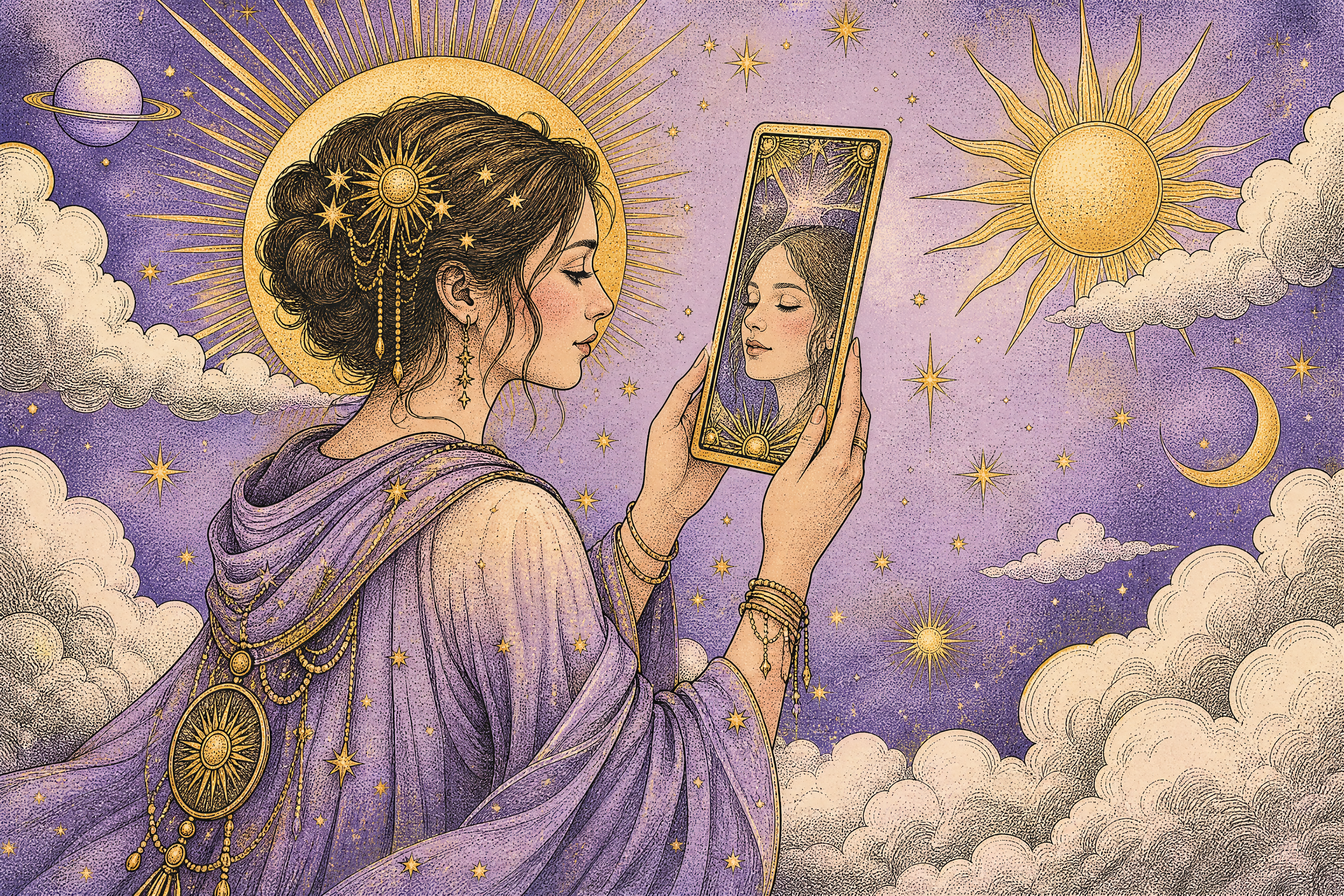
- In the therapeutic approach the card is a mirror, not a window onto the future. You ask it what is already happening, not what will happen.
- The idea rests on projection and Jung's archetypes: symbols that give a name and a picture to something vague moving inside you.
- OH cards, the projective decks used in therapy rooms, run on exactly the same principle without the fortune-telling baggage.
- You can start without buying anything. One card and three open questions is the whole practice.
- It works on people who believe none of it, because it never asks you to believe the card knows anything.
- Reflective cards are not therapy. If you are in real distress, the right move is a professional, not a deck.
What Is Therapeutic Tarot?
Therapeutic tarot is the use of tarot cards as a reflection tool rather than a predictive one. Take an image that is rich and ambiguous enough — a figure, a symbol, a half-told scene — hand it to a person, and ask them what they see in it. Whatever comes out came from them. The card supplied the prompt, not the content.
Psychology has a name for this: projection. Faced with an under-defined image, we fill it in with whatever we happen to be carrying. Therapeutic and projective card decks are built entirely on that. They do not hold an answer; they draw one out of you. The card is a mirror, not a window onto the future.
One thing belongs at the top rather than the bottom, because everything below depends on it: this is a self-reflection practice, not a form of treatment. Tarot is not therapy and cannot stand in for it. What follows is a way to think about your own life more clearly, which is genuinely useful and a much smaller thing than care.
The Psychology Behind It: Jung, Projection, and Archetypes
Carl Jung noticed that certain symbols recur across cultures that never met, and called them archetypes: the Mother, the Shadow, the Hero, the Wise Old Man. Tarot, whether by accident or by slow cultural absorption, is a nearly complete catalog of them. The High Priestess is intuition and the thing you know but have not said. The Devil is the shadow, the part of you that you would rather not claim. The Hermit is the deliberate turn inward.
What that gives you is language. When one of those cards comes up, it puts a name and a picture on something blurry that has been moving in you for weeks. Once a thing has a name, you can argue with it, describe it to a friend, or decide to do something about it. That is not mysticism. That is the very ordinary usefulness of having a word for something.
Jung is quoted approvingly on tarot all over the internet, and the quotes are thinner than the enthusiasm suggests. What is solid is the mechanism underneath: ambiguous symbolic material invites projection, and projection is informative. You do not need the mystical claim for that to be true.
Therapeutic Tarot vs. Predictive Tarot
Same deck. Different question. That is the entire difference, and it is smaller than most people expect.
A predictive reading asks what will happen: will he call, will the offer come, is this finally the year. A reflective reading asks what is happening: how do I actually feel about this job, what am I circling, what have I already decided and not admitted out loud. The first looks outward at a future nobody has access to. The second looks inward at a present you have plenty of access to and have been quietly declining to examine.
Almost everything in the tradition survives the switch intact. The card meanings read perfectly well as a vocabulary of psychological states instead of a schedule of events. The spreads still work. What drops away is the claim to knowledge nobody has. If you want the long version of why that claim does not hold up, we made it in our piece on whether tarot really works.
Have a question of your own? The cards are open.
Tarot vs. Therapeutic Card Decks Like OH Cards
The best known projective tool in the therapy world is not tarot at all. It is OH cards: a deck of images paired with a deck of words, used by therapists, group facilitators, and organizational consultants to open a conversation that is not opening on its own. Draw a picture, draw a word, set them side by side, and talk about what surfaces.
The logic is identical to reflective tarot, minus the fortune-telling association. You pull an image and you look at what it stirs up. The only real difference is reputation: tarot arrives with a mystical halo, OH cards arrive with none. In therapeutic use they do the same job — they invite you to meet yourself through a picture. Which one belongs in your hands depends mostly on which one you can hold without rolling your eyes.
Types of Therapeutic and Projective Card Decks
This shelf has grown quickly in the last decade. The categories are worth knowing before you spend anything:
- OH cards and the family of decks around them. Images and words, combined by the person drawing. The most common tool in clinics and group work.
- Emotion cards. One feeling per card, or a face expressing it. Excellent with children, and with adults who struggle to put a word on what they are feeling.
- Character and scene cards. These invite a story: who is this, what happened a moment before, what happens next.
- Word and sentence cards. More direct. Good for closing a session or naming an intention.
- Tarot read reflectively. The familiar 78-card deck in an entirely different register, which is what this post is about.
You will find these in large bookshops, in specialist and new-age stores, and online, along with printable sets you download and run off at home. For personal use, a plain printed deck does exactly the same work as an expensive one. The professional sets are priced for professionals; nothing about the mechanism requires them.
How to Use Tarot for Self Reflection
- Pull one card. The free daily card is ideal for this, because it needs no question and no setup.
- Look before you look it up. Before reaching for the official meaning, ask: what comes up in me when I look at this picture? What pulls me in? What puts me off?
- Connect it to your week. Where in the last seven days did I feel like this figure? What is she doing that I am also doing?
- Write it down. One card is an anecdote. Sixty cards is a map of your own patterns, and you cannot see the map without the notebook.
Notice what did not happen there. We never asked the card what will happen. We asked what is already happening. That single substitution is the whole method.
Ten Reflection Questions That Work With Any Card
If you are staring at a card with no idea what to ask it, take one of these. Every one is phrased so the answer has to come from you:
- What was the first thing my eye landed on?
- If the figure in this card said one sentence to me, what would it be?
- Where in the last week did I feel exactly like this?
- What about this card is uncomfortable, and why?
- What is missing from this picture?
- Who in my life does this card remind me of?
- What would I say to a friend who drew it?
- What is this card asking me to stop?
- What is it asking me to start?
- What do I already know and have not wanted to put into words?
These are also, not coincidentally, better than most of the questions people bring to a predictive reading. Asking a good question is most of the skill in either mode.
Three Spreads Borrowed From the Consulting Room
A card for the state, not the future
Instead of "what will happen with work," pull on "how do I feel about work right now." The change is tiny and it converts the whole exercise from guessing into observing. It also produces an answer you can act on today, which the other version never does.
Two cards: what I show and what I feel
Simple and unreasonably effective. Draw two: the first is what other people see, the second is what is happening underneath. The gap between them is usually the entire story, and it is frequently the thing you would have paid someone to point out.
The week-closing card
Once a week, one card, one question: what was this week trying to teach me? After two months you have a notebook that shows patterns nobody would have thought to mention to you, because nobody else was watching that closely.
Therapeutic Cards vs. Reflective Tarot: The Practical Differences
| Therapeutic card decks | Tarot read reflectively | |
|---|---|---|
| Structure | No fixed structure; every deck differs | 78 cards in an ordered system |
| Built-in meanings | None. Everything comes from the viewer | A tradition of interpretation you can lean on or ignore |
| Learning curve | Immediate | Requires getting to know the cards |
| Cultural baggage | Neutral | Mystical, which genuinely bothers some people |
| Best suited to | Groups, first sessions, hard skeptics | Solo practice and long-term pattern work |
Why It Works Even If You Believe None of It
Here is the part that surprises people: the reflective approach asks you to believe nothing. There is no claim that the card knows something, so there is nothing to accept or reject. There is an image, and there is a person looking at it.
That is precisely why these tools turn up in clinics and meeting rooms and not only in spiritual shops. They run on the same faculty that makes us see faces in clouds and figures in wallpaper, pointed at something useful for once. The image is simply a surface for your own material to land on.
If you are a skeptic, think of it as freewriting with a starting point. A blank page is paralyzing; a picture forces you to begin somewhere. That is all that is happening here, and it is enough. The mechanism stays honest as long as the framing around it does, which is why we say plainly what our own AI-written readings are: reflection and prompting, at eye level, with no pretense of prophecy or of therapy.
Where Tarot Stops and Therapy Begins
This is the most important section in the post, so it gets said without hedging.
Tarot is not therapy. It is not treatment, it is not a diagnosis, it is not a clinical relationship, and it is not a substitute for professional mental health care. A therapist who uses projective cards is using a prop inside a trained practice. The training is the practice; the cards are the prop. Buying the prop does not give you the practice, not for yourself and certainly not for anyone else.
Some concrete lines worth holding:
- Never let a card decide a medical or psychiatric question. Whether to start, stop, or change a medication is a conversation with a prescriber. A deck has no standing in it whatsoever.
- Do not use cards to diagnose yourself or anyone else. The images are ambiguous by design, which makes them useless as evidence and very good at confirming whatever you already feared.
- Watch for the loop. Pulling the same question over and over, hunting for a better answer, is a symptom of anxiety rather than a treatment for it. If the deck has become a place you go for reassurance, that is worth mentioning to a person rather than to a card.
- Do not practice on other people. Using projective cards in a helping or clinical role requires training in that role. The cards are not the qualification.
And the plainest version. If you are living with persistent low mood, anxiety that will not lift, disordered eating, substance trouble, or anything that has been making ordinary days hard for weeks, the right next step is a psychologist, a psychiatrist, a social worker, or your family doctor. If you are having thoughts of harming yourself, contact your local emergency number or a crisis line now, not later, and not after one more card.
Reflective cards can accompany a period of growth. They should never be asked to lead it alone.