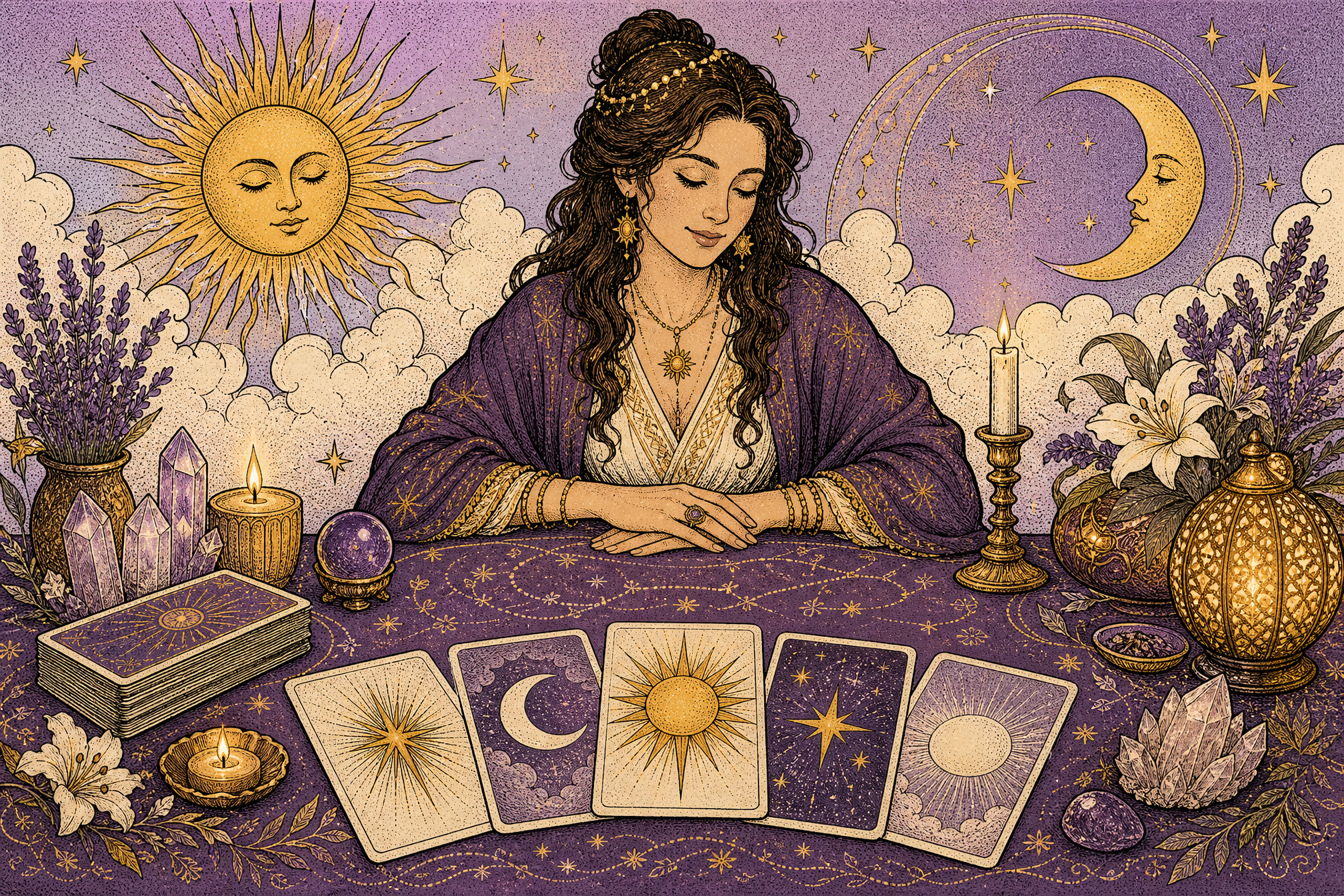
- A tarot deck holds 78 cards: 22 Major Arcana and 56 Minor Arcana split across four suits.
- Tarot began as a fifteenth-century Italian card game. The divinatory use arrived roughly three centuries later.
- The four suits map to four areas of life: emotion, material, thought, and action.
- Every reading has three parts: the question, the spread, and the interpretation that ties the symbols back to the question.
- Tarot's real power is reflection, not prediction. It shows you what you already know but haven't said.
- You don't need to buy a deck to start. One free card a day teaches faster than a boxed set does.
What Is Tarot?
Tarot is a deck of 78 illustrated cards, each carrying a symbol, a figure, or a small scene. You ask a question, the cards are shuffled and laid out in a pattern, and each card's image is read against the question you brought. That is the entire mechanism. No incense required.
The deck was invented in fifteenth-century Italy as a card game for the nobility, the "triumph" cards, which is where the word trump comes from. Nobody used it for divination for another three hundred years. Today tarot is one of the most widely practiced reflective traditions in the world, and one of the most misunderstood, mostly because film and television have spent a century using it as shorthand for doom.
Here is the honest version, and it frames everything below: tarot does not predict. It reflects. A reading is a structured way of looking at your own situation from the angles you have been avoiding.
What's in a Tarot Deck: Major and Minor Arcana
The 78 cards split into two families.
- The Major Arcana — 22 numbered cards running from The Fool (0) to The World (21). These are the famous ones: Death, The Lovers, The Tower. They speak in capital letters about the large movements of a life: change, choice, crisis, revelation. When a Major turns up, the reading is usually about something structural.
- The Minor Arcana — 56 cards in four suits: Cups (feeling), Pentacles (material life), Swords (thought), and Wands (action). These handle the everyday: the job, the argument, the small decision you keep postponing. Most readings are mostly Minors, which is exactly right, because most of a life is.
You can browse all of them in the Lunara card index, where every card has its own page with the upright meaning, the reversed meaning, and how it reads in love and in work. If you want the 22 big ones on their own, there is a full guide to the Major Arcana.
The Four Tarot Suits and What They Mean
The Minor Arcana is built like an ordinary playing-card deck: four suits running ace through ten, plus four court cards in each (Page, Knight, Queen, and King). Every suit owns a domain of life and an element.
| Suit | Element | What it covers | Playing-card equivalent |
|---|---|---|---|
| Cups | Water | Emotion, love, connection, what you feel | Hearts |
| Pentacles | Earth | Money, work, the body, what is tangible | Diamonds |
| Swords | Air | Thought, truth, conflict, what gets said | Spades |
| Wands | Fire | Creativity, initiative, drive, what you do | Clubs |
This structure is the single most useful thing a beginner can learn, because it turns 56 cards into a grid instead of a list. If you know that Swords deal with thought and conflict, and that threes in tarot tend to mark a first break or a first growth, you can guess roughly what the Three of Swords is about before you have read a word of interpretation. Learn the suits and the numbers and the Minor Arcana largely explains itself.
Have a question of your own? The cards are open.
How a Tarot Reading Actually Works
A good reading stands on three legs, and if one is missing the whole thing wobbles.
- The question. Open ("what do I need to understand about this relationship?") or closed ("yes or no?"). The question shapes everything that follows, which is why learning to ask one well is half the skill.
- The spread. Cards are drawn and placed in a pattern where each position has a job: present, obstacle, guidance, outcome. Position matters as much as the card does. The Tower in the obstacle seat and The Tower in the outcome seat are two entirely different sentences.
- The interpretation. This is where the actual work happens, connecting the symbols to the question. The same card says genuinely different things to different questions, and a reading that ignores this is just reciting a dictionary at you.
If you would rather see it than read about it, there is an annotated example of a full reading, and a longer walkthrough of how to build a reading from a single card up to a complete spread.
Where Tarot Cards Came From: A Short History
Worth knowing, because the real history dissolves a lot of unnecessary mystique.
In the 1440s, wealthy families in northern Italy commissioned hand-painted decks for a trick-taking game called tarocchi. For roughly three centuries that is all tarot was: an expensive card game. Then in 1781 a French scholar named Antoine Court de Gebelin published the claim that the deck secretly encoded lost Egyptian wisdom. He had no evidence at all, and the Rosetta Stone would not be deciphered for another forty years, but the idea caught, and card divination in France took off from there.
The version almost everyone uses today arrived in London in 1909: the Rider-Waite deck, designed by Arthur Edward Waite and illustrated by Pamela Colman Smith. Smith's innovation was to give every card a full illustrated scene, including the Minor Arcana, which until then had been plain pips, much like the numbered cards in a poker deck. That one decision is why tarot became learnable by ordinary people. You can look at the picture and understand something before you know anything.
Nearly every deck on the shelf today descends from Smith's illustrations. If you are wondering which one to actually buy, we wrote a separate guide to choosing your first tarot deck.
Does Tarot Actually Work?
It depends what you are asking it to do.
If the question is "do the cards know the future?" then no. There is no evidence for that, and anyone promising otherwise is selling something. But that was never the interesting question.
What tarot does well is reflection. The cards pull out what is already sitting inside you, the worry you have been talking around, the decision you already made and have not admitted to, the want you keep calling a maybe, and they arrange it in a form you can finally look at. Carl Jung read the deck in exactly this way: a mirror for archetypes already at work in a person. A good reading does not feel like magic. It feels like a conversation that finally said the thing precisely.
That is not a smaller claim than prediction. It is a more useful one. A structured prompt that forces you to name your own situation out loud is a real tool, and using it requires believing nothing supernatural whatsoever. We take the evidence and the psychology apart in more detail in does tarot actually work.
Common Tarot Myths, Debunked
- "Your first deck has to be a gift." A charming superstition with no grounding in the tradition. Buy your own. Nobody is coming to hand you one.
- "Nobody else can touch your cards." A personal preference wearing the costume of a rule. Some readers are protective about it, others hand the deck straight to you to shuffle. Both work.
- "The Death card predicts disaster." No. The Death card is about endings and clearing space, and that is very nearly always how it reads in a real spread. In practice it turns up as a breakup that was already over, a job you have outgrown, or a habit finally set down.
- "You have to be born with the gift." You have to know the cards and ask good questions. Intuition helps, but it is a muscle you train, not a talent issued at birth.
- "Reversed cards are the bad ones." A reversal is a shift in tone, blocked or internal or delayed or overdone, rather than a curse. More on how reversed cards work.
How to Read a Tarot Card: What's Actually on It
A typical card carries three things: a number (on the Majors and the numbered Minors), a name, and an illustration that is really a whole scene. The picture does most of the work, and most of the interpretation rests on it. Who is in the frame, where are they looking, what is happening behind them, which colors repeat.
Try this the next time you draw a card. Before you look anything up, say out loud what you see. "A figure walking away under a moon, leaving behind a stack of cups he arranged himself, and there is a gap in the row." You have just read the Eight of Cups more or less correctly. The book confirms. The picture teaches.
Which is why card-by-card meaning guides are essential at the start and not forever. After a few weeks you will notice you are reading the image before you remember the definition, and that is the exact moment the reading starts being yours.
Do You Need to Buy a Tarot Deck to Start?
Not on day one. A standard Rider-Waite deck runs about $15 to $30 and sits on the shelf of most bookshops, but there is no hurry at all. Most people who buy a deck on the first day of their curiosity leave it in the box, because 78 cards is a great many cards and a sealed deck offers no obvious place to begin.
Start with one card a day instead and learn a single card at a time. When you notice that you recognize half the deck on sight without checking the meaning, that is the moment to buy. By then you will also know which deck's artwork actually speaks to you, which is the only criterion that matters.
Online Tarot Readings: What's Real and What Isn't
Drawing cards online works, as long as you understand what is happening behind the screen. The draw itself is genuinely random, arguably more random than a hand shuffle, which is notoriously bad at mixing a deck. Randomness is not the problem.
The difference is in the interpretation. On most computerized tarot sites the text you receive was written in advance and is shown to everybody, regardless of what they asked. Card in, stock paragraph out. It is a lookup table with a shuffle animation on top.
So check two things before you take an online reading seriously: did your actual question get inside the reading, and is anyone promising to tell you the future. The first is the sign of a real reading. The second is the sign to leave. That distinction is also the whole honest case for and against reading online, which we compare properly in online versus in-person tarot, and it is why AI-written readings are either a genuine step forward or the same lookup table with better prose, depending entirely on whether your question reached the interpreter.
How to Start Reading Tarot Today
The simplest entry point: pull a free daily card. One card, a full meaning, no commitment. Do it for a week and you will know a handful of cards on sight and start noticing patterns, the same suit arriving again, the same figure returning.
When you want something with more weight, a full spread around a real question is the natural next step: four cards, four angles, one written reading that ties them into a single story. And if you only want to test the feel of it without thinking too hard, a yes or no question takes about a minute.
Two things are worth learning early, in this order: how to phrase a question, and how to build a reading out of more than one card. Everything after that is practice, and practice is the enjoyable part.