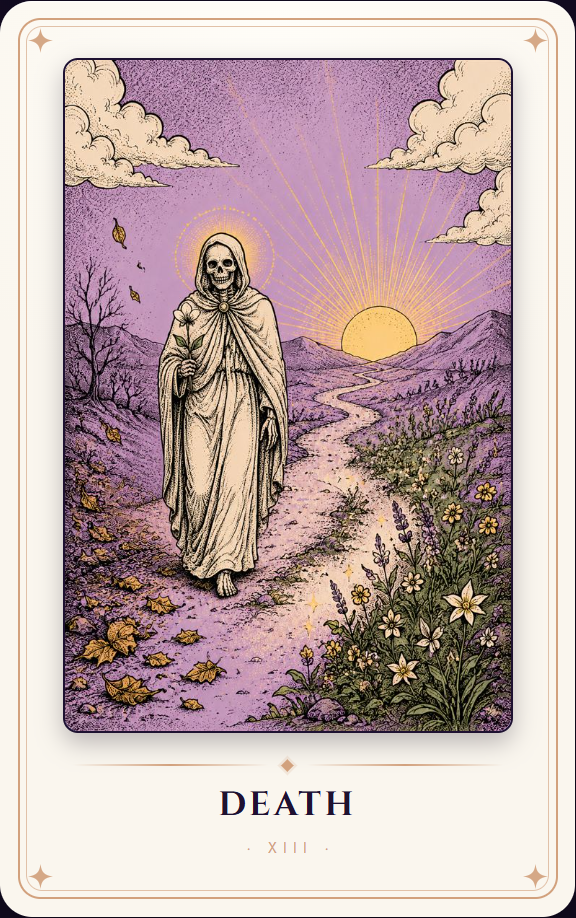
The Death tarot card almost never means literal death.
What the Death Card Means
In the traditional deck a skeleton in black armor rides a white horse, and almost everyone stops looking right there. Keep going. Behind the figure, between two towers on the horizon, the sun is rising. That detail is the entire card: every setting is followed by a sunrise. Death is the deck's card of transformation, not of loss.
When it turns up, it is saying that something in your life has finished its work. Not that it is about to finish — that it already has, and that holding on is no longer loyalty, it's delay. Which means the useful question isn't "what am I about to lose?" It's "what ended a while ago that I still haven't admitted?"
Most people feel relief once they sit with this card rather than react to it. Death doesn't take anything away from you. It gives you permission to put it down.
Death in Love and Relationships
In a love reading, Death points to the end of a phase, not necessarily the end of the relationship. Usually it marks the closing of the current chapter: the old dynamic, the habits that hardened, the version of the two of you that stopped fitting somewhere back there. Couples who walk through this card together tend to come out the other side more honest with each other than they went in.
If you're single, it reads more literally. Death is the card of genuinely releasing someone from the past — not "getting over it" in the performative sense, but the quiet moment you stop editing the story of what happened. That release is almost always the precondition for anything new, which is why Death sitting beside The Lovers so often marks a beginning rather than an ending.
Death in Career and Money
Here the card is close to pure good news for anyone willing to move. A role that has taught you everything it can teach. A field quietly asking for a change of direction. A project that deserves a decent burial instead of another quarter on life support. That "just one more quarter" instinct is precisely what Death has come to name.
On money questions it points at commitments that outlived their reason: a subscription, a loan structure, a spending habit inherited from a version of your life that no longer exists. Cancel one of them this week. The card rewards the gesture far more than the sum.
Curious what Death means for your own question?
Death Reversed
Death reversed is the change that got stuck. You know exactly what needs to end — you could name it in a single sentence, and you probably just did — and you are not letting go. The reasons are usually decent ones: fear of the empty space afterward, loyalty to an older version of yourself, or plain habit wearing the costume of commitment.
The reversed card doesn't scold. It shows you the running cost of the grip: the energy it takes, the attention it eats, the room it occupies where something else could be. Then it asks how much longer that price is worth paying.
Is Death a Yes or No Card?
Death leans toward "not in this form." It rarely closes a door outright; it says the thing you're asking about cannot continue in its current shape. If the question is "should I end this?" Death is close to a yes. If the question is "will this go back to how it was?" the answer is no, and the card is unusually blunt about it. In a yes or no spread that distinction is exactly what the written interpretation exists to draw.
Common Death Card Combinations
- Death + The Sun: the ending leads straight somewhere bright. A change with a good outcome already written into it, and one of the most reassuring pairs in the deck.
- Death + The Tower: a large, sudden change. Better to choose it before it chooses you — The Tower is often what happens when Death gets ignored long enough.
- Death + The High Priestess: the ending is ripening quietly. Don't announce anything yet. Listen first.
- Death + The Star: release followed by real healing. The hardest part is already behind you, whatever it currently feels like.