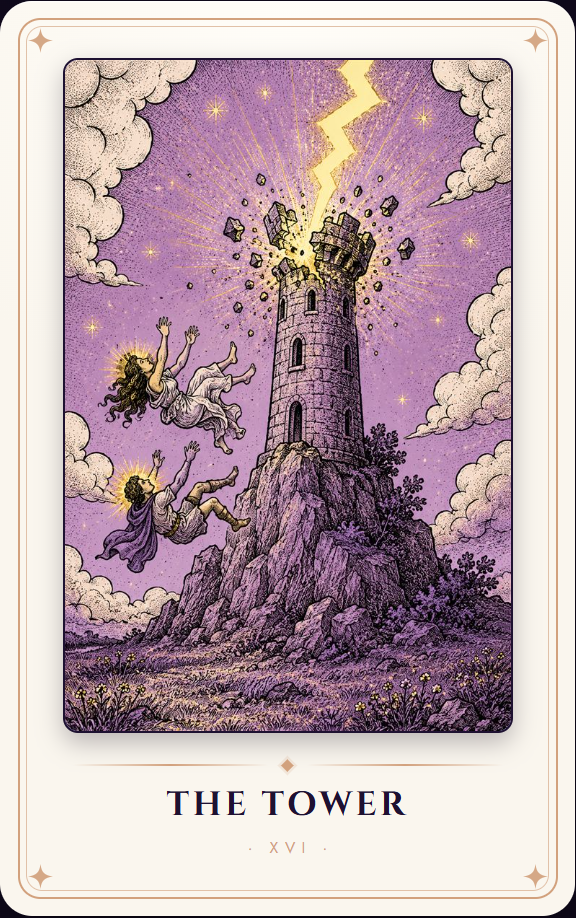
The Tower tarot card marks a sudden break in something built on shaky ground — and why that's good news.
What The Tower Card Means
Look at where the tower is standing. In the traditional image it sits on the peak of a narrow crag: tall, impressive, and structurally impossible. The lightning doesn't destroy it. The lightning reveals that it was never stable. In a reading, The Tower marks a moment of truth: an assumption collapses, a secret surfaces, a plan comes apart, and all at once you can see what was there the whole time.
This is not pleasant, and there's no point pretending otherwise. It is also, almost always, in your favor. People looking back at a Tower moment in their own lives report the same thing with unnerving consistency: I only wish it had happened sooner.
The Tower in Love and Relationships
In relationships, The Tower describes a shock that exposes the foundation. A conversation that got away from both of you and revealed what you actually feel. A discovery that forces the relationship to be defined again from scratch. An arrangement that had been quietly untenable for a year finally saying so out loud.
Be precise about what the card claims here, because most readings overreach. The Tower does not say the relationship is over. It says the crooked version of it is over. Relationships built on something true tend to come out of Tower moments sturdier than they went in. Relationships held together by avoidance tend not to — and that, uncomfortably, is also an answer.
The Tower in Career and Money
A sudden restructuring, a project that collapses, the sharp realization that the current track leads nowhere you actually wanted to go. The Tower at work is the moment you stop renovating the third floor of a building with cracks in the foundation.
Its practical instruction is short: don't waste the crisis. A Tower period is the rare window where the usual objections stop applying and you can genuinely build differently. On money, it's the card of the bill that finally comes due — the reckoning that was always arriving, just not on a date you had marked.
Curious what The Tower means for your own question?
The Tower Reversed
The Tower reversed is the deferred collapse. You're holding cracked walls up by hand, spending an enormous amount of energy preventing something that is coming anyway. Sometimes it means the upheaval has already happened internally and only the admission is running late.
The reversal softens the blow and stretches it out. Whether that's a good trade is the actual question the card is asking, and only you can price it.
The Tower vs Death: What's the Difference?
They get confused constantly, and the distinction is worth having. Death is a ripe ending: a process that completed on its own schedule and is now asking to be acknowledged. The Tower is a sudden break in something that was assembled wrong. Death closes a chapter. The Tower reveals the chapter was written on the wrong page entirely. Death gives you the choice of when to let go; The Tower takes it out of your hands.
What to Do When You Pull The Tower
- Don't decide anything today. The first forty-eight hours of a Tower moment are the worst possible time to make a permanent choice.
- Ask what you already knew. Nearly every Tower has a quieter card standing behind it: something you had noticed and set aside. That's The High Priestess territory, and it's worth revisiting now.
- Stop holding the wall. The energy going into prevention is energy you're going to need for what comes next.
- Protect the boring things. Sleep, money, the people who are steady. Upheaval is survivable; upheaval on four hours of sleep is harder than it needs to be.
Common Tower Card Combinations
- The Tower + The Star: the deck's most famous sequence, and they sit side by side for a reason. After the break comes quiet hope and genuine healing — The Star is the card of the morning after.
- The Tower + Death: a chapter closing with drama attached. The release on the far side is unusually large.
- The Tower + The Lovers: a shock that forces a decision in a relationship you've been postponing for too long.
- The Tower + The Sun: the truth that surfaced hurts, and the light on the other side of it is closer than it looks from here.