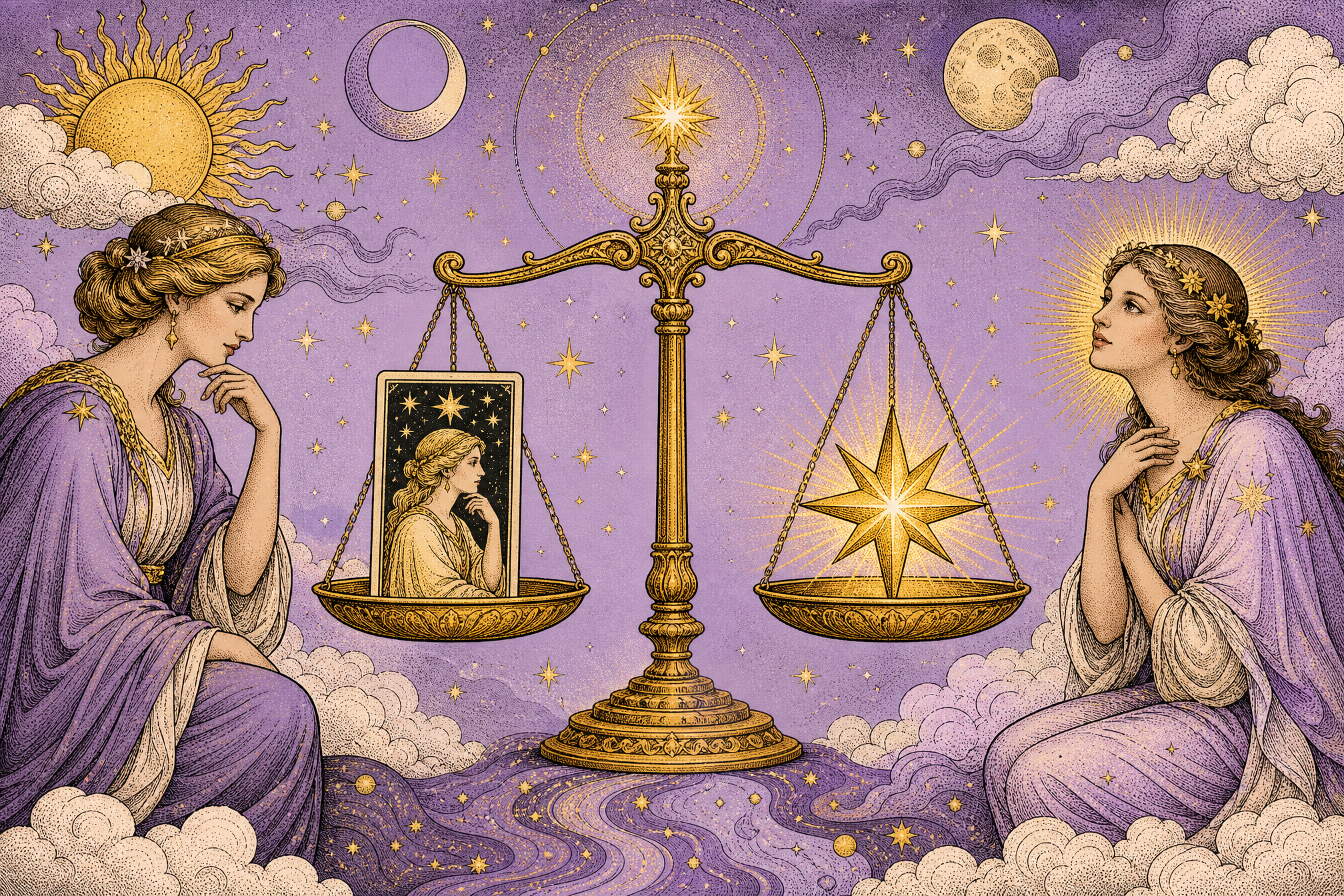
- If you are asking whether the cards know the future, there is no evidence for that, and we are not going to pretend otherwise.
- If you are asking whether they help you think clearly about something you are stuck on, the answer is yes.
- The Forer effect and confirmation bias fully explain why a reading feels uncannily accurate — and explaining the feeling does not erase the value.
- Tarot's power is as a reflection tool, not a prediction machine. Those are two separate claims, and only one of them survives scrutiny.
- You can test the whole thing yourself in two weeks, for free: one card each morning, two lines written before you look anything up.
Can Tarot Predict the Future?
No. There is no evidence that a printed card knows what happens to you next Thursday, and anyone who promises otherwise is selling something. We say that on a tarot site, in the opening line, because the honesty is our actual position and not a disclaimer bolted to the bottom of the page. The cards are not prophets.
If that settled the matter, this post would be three sentences long and you would be right to close the tab. It does not, because "can it predict the future" is only one of the questions buried inside "does tarot really work," and it is the least interesting one in the pile. If you are new to the deck entirely, the beginner's guide to tarot covers the mechanics; this post is about whether any of it holds up.
The Skeptic's Case Against Tarot
Most tarot sites either ignore the skeptical argument or wave vaguely in its direction before changing the subject. It deserves better than that, because it is a good argument. Here it is at full strength.
- Cold reading. A live reader is watching you. They register the pause, the ring, the shift in your voice when your brother comes up. They offer something general, read your face, and narrow. Done well it looks like second sight. It is an ordinary human skill performed quickly.
- Barnum statements. "You seem self-assured to other people, but privately you second-guess yourself." Nearly everyone reads that as personally accurate. In 1948 the psychologist Bertram Forer handed his entire class the same personality profile, quietly assembled from a newsstand astrology book, and they rated it 4.26 out of 5 for how well it described them specifically. A tarot deck is 78 images broad enough to do the same job.
- Confirmation bias. A month later you remember the line that landed and have quietly discarded the three that missed. In memory, every reading was a hit.
- Randomness. The card on top is the card on top. Nothing about the question in your head reaches into the deck and arranges it.
We are not going to dispute any of that. All four are accurate descriptions of what happens during a tarot reading. The interesting part is what you think follows from them.
What the Skeptical Case Actually Proves
The usual conclusion is that these mechanisms expose tarot as empty. We think they show something narrower and considerably more useful: the meaning in a reading comes from the person sitting with the cards, not from the cards.
That is a real finding, and it demolishes exactly one claim — the claim that the deck knows things. It leaves the other claim standing. If a random image reliably gets you to articulate a worry you have been circling for a month without naming, the mechanism behind it is not what matters to you at eleven at night. What matters is that you now have language for the thing. The Forer effect explains why the sentence felt tailored. It does not explain the sentence away.
So the honest framing is this: tarot works the way a good question works, not the way a weather forecast works. That is a much smaller claim than the industry usually makes, and it is one we can actually defend.
Have a question of your own? The cards are open.
What a Tarot Reading Is Genuinely Good For
Strip out the mysticism and four things are happening in a reading, all of them recognizable from ordinary life.
- It forces you to say the thing. To ask the cards anything at all, you first have to state what is bothering you. Most people never do this out loud in a given year. Half the value is delivered before a single card is drawn, which is why how you phrase the question shapes the reading more than the draw does.
- It hands you an outside vantage point. A random image interrupts the loop you have been walking in circles for two weeks. It is hard to keep telling yourself the same story when something unrelated is lying on the table waiting to be fitted into it.
- It gives you permission to speak. Saying "The Devil came up, and that card is about being bound to something you keep choosing" is easier than saying "I know this job is bad for me and I have not left." The symbol carries a sentence you could not carry yourself, and once it has been said, it stays said.
- It bounds the time. A single-card reading creates a defined ten minutes in which you stop and look at your own life. In a week where nothing else creates that, ten minutes is not nothing.
None of those four require anything supernatural, and each of them changes something real. That is why we are comfortable saying tarot works, and equally comfortable refusing to say it predicts.
Carl Jung, Tarot, and the Card as a Mirror
Carl Jung treated symbolic images, tarot among them, as a way of surfacing archetypes already at work inside a person, and every tarot site on earth quotes him for exactly that reason. Worth being straight about it: Jung's interest is a framing, not evidence. He was a psychiatrist with a particular theory of the unconscious, not a replicated result.
The framing is still useful. What it says is that when a card appears to know you, what you have actually met is a projection surface. You supply the content; the image supplies the shape and the excuse to look. That is a modest, checkable description of what happens in a reading, and it holds up far better than "the deck is attuned to your energy."
What Does the Research Say About Tarot?
Plainly: there is no research showing that tarot cards predict events, and no reason to expect any. Nobody has run the study that comes out the other way, and no mechanism exists that would make such a result possible.
What does exist is a substantial body of practice around symbolic cards as a clinical and facilitation tool. Therapeutic card decks are used by therapists, group facilitators, and counselors to open conversations that direct questioning stalls on. The value there is documented and entirely unmysterious: an image slips past a person's defenses faster than an interview does, and gives them something to point at instead of something to confess.
Two very different claims are hiding inside the word "works," and the distance between them is the entire argument. "The cards know" has nothing behind it. "The cards help you think" is ordinary, modest, and well supported.
Skeptics and Believers Are Asking the Same Question
It is worth noticing that "is this real?" arrives from two opposite directions, and in both cases it is hunting for the same thing: is somebody here working me?
The skeptic asks because they do not want to be the person who got taken. The believer asks because they want to trust the answer they just received. Both are right to be suspicious, because this field genuinely does contain people selling certainty. And both are satisfied by the same answer: the cards do not know, the cards reflect.
We treat that as an advantage rather than a weakness. A service that does not require you to believe anything in order to get something out of it is a service you can evaluate for yourself, without buying a worldview up front. It is also why we can publish this post without contradicting ourselves. A site whose business model rests on "we know what is going to happen" cannot afford the paragraph you just read. Ours can, because what we offer stands up without that promise. The same logic runs through how we think about AI-written readings: an interpretation is a mirror held steady, not an oracle.
When Tarot Does More Harm Than Good
There are situations where our answer is to put the cards down, and we would rather say so out loud than let it go unmentioned.
- As a substitute for professional help. Medical, psychiatric, legal, and financial questions need a professional. There is no version of this where a card is the right tool.
- When it turns into dependence. Someone who consults the deck before every small decision is outsourcing the exact muscle they most need to keep using.
- When a reader frightens you and then sells the cure. There is a block on you, and it can be removed for a fee. That is not a reading. That is a sales funnel with candles.
- When you use it to surveil other people. What is he thinking, what is she planning. It does not work, it is not fair to them, and it keeps you stuck inside a question that was never yours to answer.
How to Test Whether Tarot Works for You
Arguing about this is far less useful than measuring it. The cheapest experiment available takes two weeks and costs nothing.
- Every morning, draw one card and write two lines: which card came up, and what it brings up for you today.
- Do not read the official meaning until after you have written your own.
- At the end of each day, add one line: was any of that actually relevant?
- After two weeks, read the whole thing straight through in one sitting.
What most people find is not accurate prediction. It is something more interesting: recurring patterns in what they keep asking about and what keeps bothering them. That is precisely what this tool does, and it is the strongest evidence you will ever get, because it is yours and you generated it.
If two weeks pass and nothing happens, that is a legitimate result too. Some people simply get nothing from this, the same way some people get nothing from journaling or from meditation. Better to discover that in fourteen free days than after a paid session.
So, Does Tarot Really Work?
Yes, if you are asking the cards to help you see your own situation more clearly. No, if you are asking them to tell you what is going to happen. That is not a dodge. It is the only distinction in this field that actually matters, and most of the confusion around tarot comes from letting two very different questions share one word.
The cheapest way to find out where you land is one free daily card. Draw in the morning, write a line about what surfaces, check it against your evening. After a week you will know exactly what this does for you, without having to take anyone's word for it, including ours.