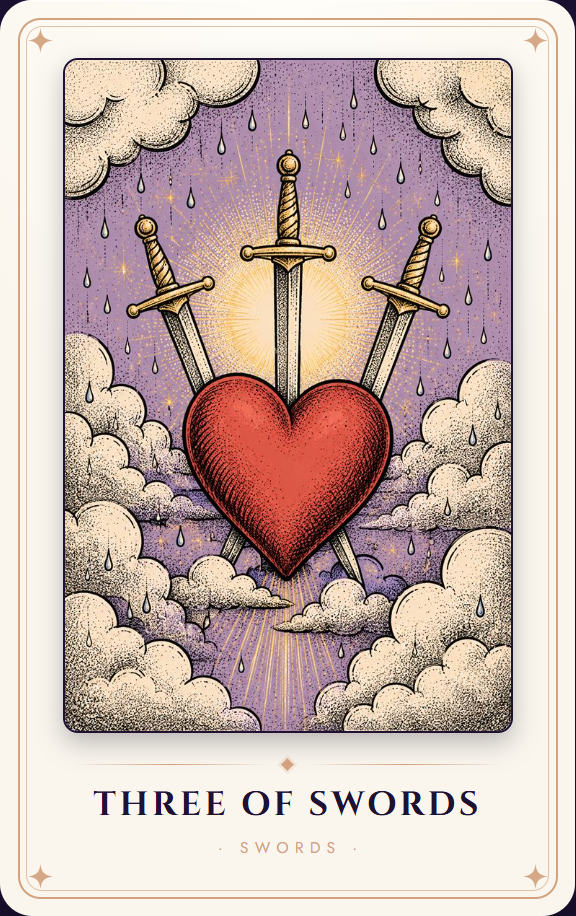
The Three of Swords is the tarot card of heartbreak and the start of healing.
What the Three of Swords Means
This is the card of clean pain: heartbreak, a truth that landed badly, grief for what happened or for what now won't. Notice what the picture leaves out. There is no suffering figure, no audience, no theatrics. Just the heart, the blades, and the weather.
In a world that reaches for "it'll be fine" within about four seconds, there is something genuinely medicinal about a card that says instead: this hurts, and it is allowed to hurt. Grief that gets acknowledged moves through. Grief that gets talked over settles in and stays.
And the rain is the optimistic detail, not the bleak one. Rain washes things, and rain stops.
Three of Swords in Love and Relationships
In love readings this card speaks of a breakup, a betrayal, a disappointment, words that cut, or a truth that surfaced and hurt on arrival. When it describes the present, its instruction is to give the grief its place rather than hurdle it. A heart allowed to ache recovers faster than a heart required to perform being fine, and that is not sentimentality, it is simply how it works.
When it describes the past, it asks something quieter. Is the old wound still running the current relationship? Old pain makes a reasonable teacher and a terrible manager, and the difference between the two is worth checking every few years.
One detail is worth holding onto. The swords are through the heart, but the heart in the picture is whole. It is not shattered, not in pieces. It has been cut, and cuts close.
Does the Three of Swords Mean a Breakup?
Not necessarily. The Three of Swords means pain, and pain comes in shapes that have nothing to do with separation: a disappointment, a sentence that landed wrong, a fear voiced badly, an old grief resurfacing at an inconvenient moment. When it does concern a breakup, it describes the hurt of it rather than decreeing that it has to happen.
What shapes the reading is the company it keeps. Beside the Ten of Swords it leans toward a genuine ending. Beside The Star, or the Four of Swords, it leans toward a wound already closing. On its own it is a description of the weather, not a verdict on the relationship.
Curious what Three of Swords means for your own question?
Three of Swords in Career and Money
At work this is sharp disappointment: criticism that stung, a promotion that went elsewhere, a project rejected, a colleague who turned out not to be one. The pain is real and deserves a day or two before you draw conclusions from it. Career decisions made from a fresh wound tend to come out too sharp, and they are hard to walk back.
Once the rain passes, the truth that got exposed becomes an asset. You now know exactly what you can rely on and exactly what you cannot — expensive information that you have, unfortunately, already paid for.
Three of Swords Reversed
Reversed, the card usually marks the beginning of recovery: the swords being drawn out, the wound starting to close, the ability to talk about what happened without it costing what it used to cost.
Sometimes it points the other way, at grief that was never given room and therefore never moved, kept inside where it goes stale and quietly sours everything near it. One question separates the two readings. Have you told anyone? Pain that gets spoken heals. Pain kept secret sets.
Common Three of Swords Combinations
- Three of Swords + The Star: after the rain, real healing. One of the most comforting pairs in the deck.
- Three of Swords + Four of Swords: the prescription is rest, not analysis. Stop replaying the conversation at 2am.
- Three of Swords + Six of Swords: the hurt is behind you and the crossing has begun. The Six of Swords is the card of calmer water.
- Three of Swords + Death: the grief belongs to something that has genuinely ended. Mourn it properly and let it close.