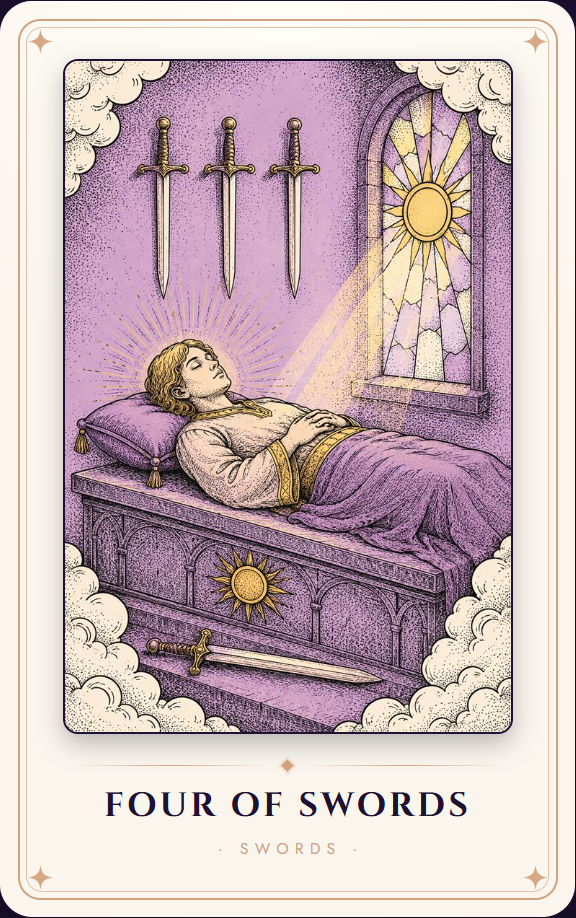
The Four of Swords is the tarot card of rest: stop before you get stopped.
What the Four of Swords Means
After the pain of the Three comes the good sense of the Four: a deliberate retreat in order to recover. The knight has put the sword down, but it is lying right there beside him, within reach. This is not surrender. It is an interval.
The card draws a line between two kinds of stopping. There is the pause you choose, which refills you, and there is the pause that gets imposed when you ignore the first one long enough: the illness that arrives the day the deadline passes, the tiredness no weekend touches. The Four of Swords almost always turns up to point out that the first option is still available, and considerably cheaper.
Four of Swords in Love and Relationships
In love this card asks for quiet. A break from dating after a draining stretch. Breathing room inside an intense relationship. An agreed pause in the middle of an argument that has escalated past anything useful.
Be precise here, because this is where the card gets misread. A pause is not a breakup, and the Four of Swords is not recommending that you disappear. It is recommending that you say: I need an hour to breathe, and I am coming back. The gap between those two behaviors is the entire difference between rest that repairs a relationship and silence that erodes one.
Four of Swords in Career and Money
This is the burnout-prevention card: the vacation postponed for the fourth time, the weekend you actually disconnect on, the project that needs a lower gear for a fortnight. It tends to arrive exactly when there is no time to stop, which is precisely the condition it has come to describe.
On money it counsels a quiet season. No big moves, no dramatic restructuring, nothing irreversible. Let things settle and look again with a rested head, because decisions made on empty are reliably worse than the same decisions made after a night of proper sleep.
Curious what Four of Swords means for your own question?
How Long a Four of Swords Pause Should Last
The card names a principle rather than a duration: stop before you are stopped. Sometimes that is one genuinely screen-free day. Sometimes it is a real holiday. The measure is not length but the feeling on the way back — you have rested enough when you start missing the sword, not while you are still afraid of it.
If a week off changes nothing at all, then fatigue is probably not the whole story and this card is not the whole reading. Look at what else came up beside it.
Four of Swords Reversed
Reversed, the card reads one of two ways. Either the rest is over and your strength has returned, in which case it is time to stand up and pick the sword back up. Or the warning went unheard, and the body has begun enforcing the pause on its own terms: tiredness that sleep doesn't touch, small illnesses on repeat, concentration that keeps slipping away mid-sentence.
If it is the second reading, don't negotiate with the need for rest. It wins in the end. The only variable left is what it charges you for the delay.
Common Four of Swords Combinations
- Four of Swords + Nine of Swords: the anxiety is exhausting you, and the first treatment is genuine rest rather than another lap of the same thoughts.
- Four of Swords + The Hermit: a pause that turns into perspective. The Hermit makes the silence useful, not merely restorative.
- Four of Swords + The Chariot: you rest in order to travel far. The stop is part of the journey, not a detour from it.
- Four of Swords + Three of Swords: recovery from something that genuinely hurt. Give it time rather than analysis — the Three of Swords asks for care, not a post-mortem.