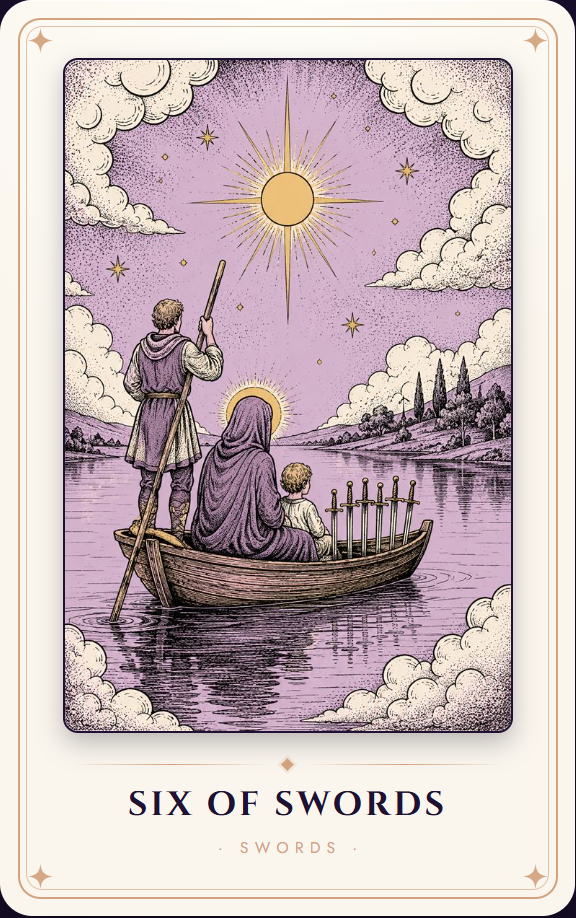
The Six of Swords is the tarot card of transition: leaving a hard place for calmer water.
What the Six of Swords Means
This is the deck's card of moving on, and its details are exact. The swords are in the boat rather than left on the shore: you take the lessons and leave the battlefield. There is no drama in this departure. No slammed door, no speech, no final word. Just a quiet conclusion that this place is no longer good for you, and then motion.
That is worth noticing, because it runs against how we picture big changes. The genuinely large transitions in most lives are made quietly. You pack what is worth keeping, and you go.
The calmer water ahead is not an illusion; it really is there. But look at the image again: you are still in the boat. The crossing is underway, not complete, and that unsettled in-between feeling is the card's honest description of where you currently stand.
Six of Swords in Love and Relationships
In love this card describes leaving a hard emotional place: recovery after a breakup, a relationship coming out of a crisis into a quieter stretch, or the calm private recognition that it is time to go.
It is softer than the Three of Swords, because the pain is behind you rather than on top of you, and more sober than the deck's outright optimists, because the peace is still ahead. For couples it says something specific and rather tender. You are crossing this in the same boat, and at the moment that matters more than the destination does.
Does the Six of Swords Mean I Should Leave?
The Six of Swords says a move toward calmer water is already happening or already ripening — it rarely arrives to open the conversation. Sometimes that means a literal departure. Just as often it is an internal one: a change of stance, an argument you stop having, an expectation you finally set down.
What it never recommends is staying inside a storm out of habit. If you are asking the question at all, the card's reading is that some part of you has already pushed off from the dock.
Curious what Six of Swords means for your own question?
Six of Swords in Career and Money
At work this is the classic transition card: a new role, a move to another city or country, an exit from a toxic environment into somewhere quieter. It confirms the direction and adds two corrections. Take the lessons with you, since the swords ride in the boat. And do not expect the new shore to feel like home on the first day, because adjustment is part of the crossing rather than evidence that you chose wrong.
On money it marks a stabilizing period after turbulence. Let it stabilize. Nothing here calls for a dramatic move.
Six of Swords Reversed
Reversed, the crossing stalls. You leave without leaving. You find yourself missing the thing that was hurting you. Or you load into the boat everything that should have stayed on the shore: resentments, habits, the well-rehearsed story about what happened and whose fault it was.
Its question is sharp and fair. Are you actually sailing, or rowing in circles near the dock? A real transition requires letting go of the rope, and that is a separate act from getting into the boat.
Common Six of Swords Combinations
- Six of Swords + Death: the ending is complete and the passage is clean. A chapter genuinely closing — and the Death card is far gentler than its reputation suggests.
- Six of Swords + The Star: the calmer water turns out to be a place of healing. The crossing was worth making.
- Six of Swords + Three of Swords: you are leaving a genuine hurt behind you. The grief is real, and it is receding.
- Six of Swords + The World: the transition completes something larger. This is an arrival, not only a departure.