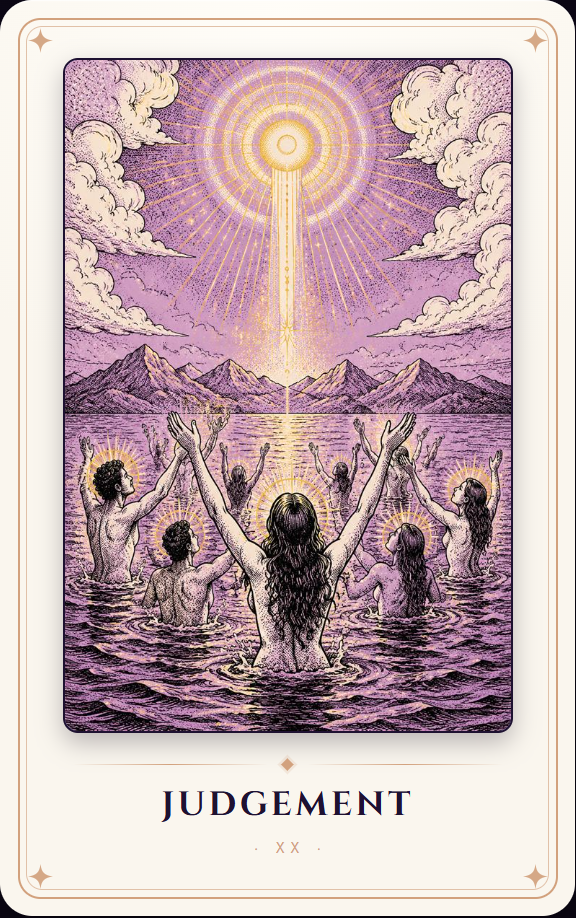
The Judgement tarot card is a wake-up call, not a sentence: reckoning, forgiveness, and a genuine second chance.
What the Judgement Card Means
Judgement is the second-to-last card of the Major Arcana, and its job is to settle the account of the whole journey: an honest reckoning, forgiveness of yourself and of other people, and getting up as a new version. The trumpet is the internal call almost everyone recognizes, the sudden unarguable clarity that this cannot continue in its current shape. The figures rise out of coffins, meaning out of the old life, out of an identity that got too small to move in.
The name does the card a disservice in English. The judgement here is not a sentence handed down from outside. It is the assessment you finally make yourself, with one important addition: it arrives with an offer attached. Rise. A verdict closes a case. This one opens one.
Card 20 also carries the deck's clearest sense of calling, vocation in the old sense of the word. Something you were meant to be doing has been knocking for a while, and Judgement is the card that says the knocking is not going to stop on its own.
It is worth noticing what the figures in the image are not doing. Nobody is pleading, nobody is mounting a defense, and nobody is waiting to be told the outcome. They are already on their feet with their arms open, before any verdict gets announced, and that is the card's actual instruction. The rising is the answer. It is not the reward for receiving a good one.
Judgement in Love and Relationships
In love readings Judgement is a reconciling moment of truth: the honest conversation that settles old accounts, the forgiveness that clears space, either between partners or between you and a romantic past still occupying square footage. It is the deck's second-chance card. An old relationship can return in a more grown-up form, and a current one can come back to life after a dormant stretch, on a single condition. Both people have to actually rise, rather than climb back into a comfortable coffin.
Its question is direct, and worth sitting with rather than answering quickly. Who are you still judging, and what would be released if you stopped?
Judgement in Career and Money
At work Judgement is the vocation card. It shows up at the moment you admit that the current track, however successful it looks from outside, no longer answers the call, and that a retraining, a shelved initiative, or a sense of purpose you filed away is asking to stand up. It also appears at genuine summings-up: the end of a project, an annual review, an honest accounting.
Its advice is practical. Write the professional reckoning, meaning what you learned, what you are releasing, and what you are answering now, and then actually rise: one concrete step that converts the insight into an action with a date attached to it. If calling is the live question rather than a passing mood, your tarot birth card is a useful companion piece, since it describes the lesson you keep circling back to across a lifetime. In money terms Judgement usually means facing numbers you have been avoiding, which is less dramatic than it sounds and almost always a relief.
Curious what Judgement means for your own question?
Judgement Reversed
Reversed, Judgement is the call being muffled. The trumpet keeps sounding and you keep turning up the noise so you do not have to hear it. It shows up as a postponed reckoning, as brutal self-judgement standing in where forgiveness should be, or as clinging to a version of yourself that stopped being true some time ago. It asks one plain question: what do you already know, and still are not getting up to do?
There is a gentler version of the same reversal, and it is far more common than the dramatic one. You heard the call, agreed with it completely, described it to a friend over dinner, and then changed nothing. Judgement reversed is very often just the gap between an insight and a calendar.
Common Card Combinations
- Judgement + Death: full transformation. One card closes the chapter, the other calls the next one by name.
- Judgement + Justice: a double reckoning, one inner and one official. Settle the accounts on both fields.
- Judgement + The World: the awakening runs straight into completion. This is the last stretch of a long road.
- Judgement + The Devil: the call is loud and the chain is still on. Forgiveness first, then the step.