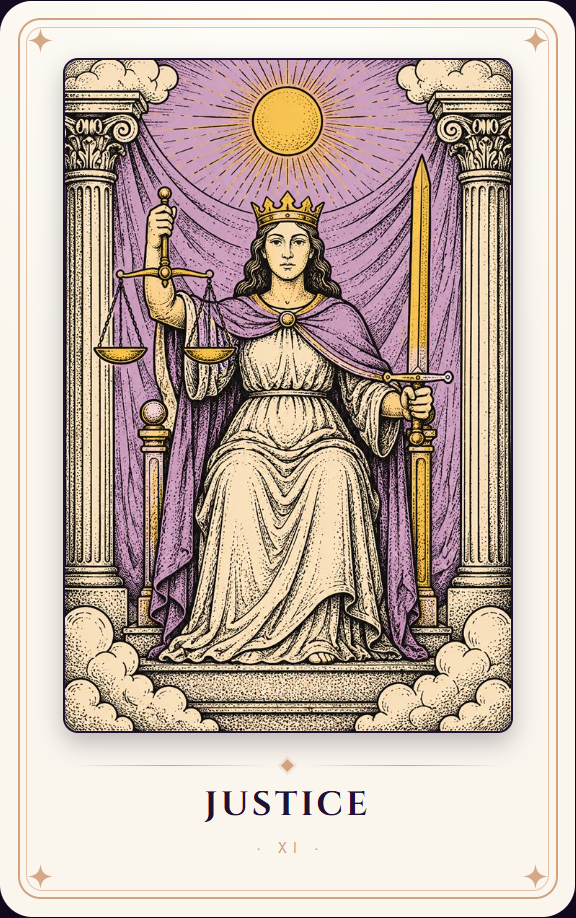
The Justice tarot card means truth, fairness, and consequences: what you plant, you harvest.
What the Justice Card Means
Justice stands on three legs. Truth, which means seeing the situation as it is, including your own part in it. Fairness, the balance between give and take, mine and yours. And consequence, the understanding that today's reality is the harvest of yesterday's planting.
The missing blindfold matters. This is not blind justice, the modern courthouse version; it is a card that looks directly at the specifics before it weighs them. In a reading it turns up around heavy decisions, around formal matters such as contracts, agreements, institutions and sometimes literal legal proceedings, and around any moment that calls for an honest accounting with yourself.
It has one habit worth knowing about in advance. Justice is completely unmoved by how badly you want something. It weighs what you did.
Justice in Love and Relationships
In love readings Justice asks the scales question: is this fair? Who gives how much, who always concedes, and are both people being judged by the same set of rules? It shows up at decision points — commit, leave, define — and recommends making the call with a clear head rather than mid-feeling. Write it down. Weigh it. Be precise about what you are actually deciding.
It's also the card that separates a grievance from a pattern. One unfair week is weather. A year of the same imbalance is a structure, and structures get renegotiated rather than complained about.
In separations and divorces it also touches the formal side: agreements, fair division, the paperwork nobody wants to think about. And above all it makes one correction that saves relationships. A healthy partnership does not require perfect equality on any given day. It requires a fair balance over time, and keeping a daily scorecard is its own quiet form of unfairness.
Justice in Career and Money
At work Justice governs contracts, negotiation, performance reviews, and any situation where somebody does or does not get what they are owed. It backs you in claiming what's yours — fair pay, credit for your work — with exactly the same force that it requires fairness from you toward everyone else. It doesn't take sides. It takes ledgers.
Advice in the card's own spirit: get the important things in writing. Justice likes precise wording and documentation, not out of suspicion but for clarity, since most disputes are simply two people remembering the same conversation differently. On money it points to consequences arriving in either direction — the debt that comes due, or the payoff from work you did properly a year ago. If a review or a raise conversation prompted the question, bring evidence rather than feeling. The scales respond to specifics.
Curious what Justice means for your own question?
Justice Reversed
Reversed Justice describes a distorted scale. That can mean unfairness that persists because it is convenient not to look at it, or an avoidance of responsibility: the "everyone is to blame except me" reading, which is the one people expect.
But it has a quieter form that gets missed. Self-judgment set far too harsh, scales weighted specifically against you, a standard you would never apply to a friend. It can also mark a formal matter that is delayed or getting tangled. The question it puts on the table is direct: which truth are you postponing because admitting it would cost something?
Justice vs. Judgement
These two get mixed up constantly, and the difference is clean. Justice weighs action against outcome — a cool, precise accounting of what happened and what it earned. Judgement is an awakening, an inner call to rise and change, and it points forward rather than back. One closes an account. The other opens a chapter.
Common Card Combinations
- Justice + The Emperor: formal matters at their best. Structure, contract, a framework that holds fairly.
- Justice + The Wheel of Fortune: the current turn is the harvest of an old planting, either to enjoy or to repair.
- Justice + The Tower: a truth that surfaces all at once. Far better to get ahead of it with a voluntary admission.
- Justice + The Lovers: a choice that has to be fair as well as wanted. Both tests, not one.
- Justice + The Devil: an arrangement that survives only because nobody has audited it out loud.