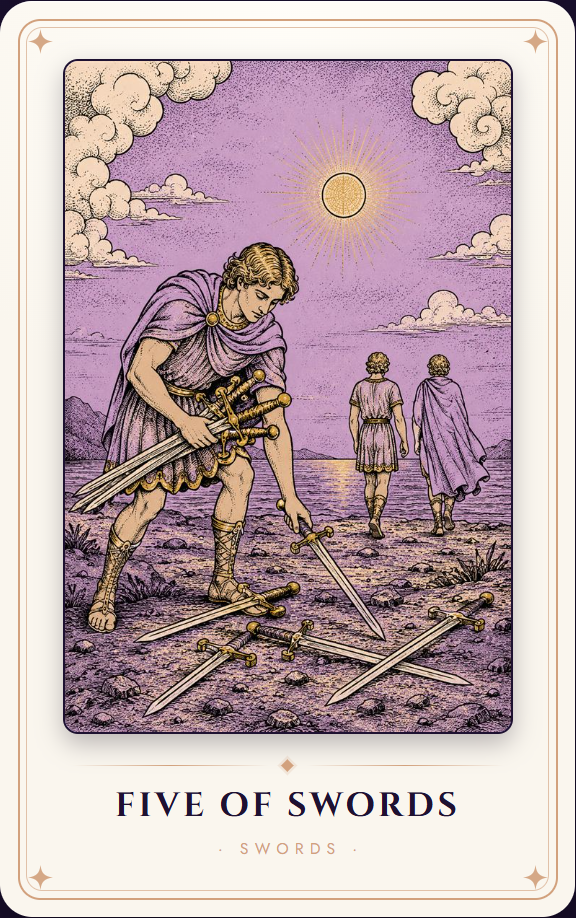
The Five of Swords is the tarot card of winning badly: victory with a price tag.
What the Five of Swords Means
This card asks the question winners tend to skip: what did that victory actually cost me? The man with the swords did win. He is also alone in a field, watching two people leave.
The Five of Swords describes conflicts in which being right outranked being decent — arguments won on points and lost on people. It is not pacifist about this. Some fights are necessary and the card knows it. What it insists on is doing the costing before the fight rather than after: is this hill worth what standing on it is going to take?
Five of Swords in Love and Relationships
In love this is the card of the corrosive argument. The one where the sharpest available sentence gets used because it happens to be available, where the need to win runs over the need to understand, where old grievances get kept like a running score.
It states the plainest fact about couples anywhere in the suit: when you beat your partner, two people lose. If this card came up after a fight, the useful question is not who was right. It is who will be brave enough to put the sword down first, and it is worth knowing that putting it down first is not the same as conceding the point.
Five of Swords in Career and Money
At work the Five of Swords is office politics: credit quietly reassigned, a victory won by reply-all, competitiveness that curdled into something else. It also warns about business wins that cost more than they return, like squeezing a negotiation until the client walks, or cutting a supplier loose and discovering how small the industry actually is.
The advice is old-fashioned and holds up. Keep your integrity even when the people around you are playing dirty. Fields have long memories about how people fought in them.
Curious what Five of Swords means for your own question?
Five of Swords as Advice: Should You Fight This One?
As advice the card does not say back down. It says price it first, and three questions do most of the work: what do I actually gain by winning, what does it cost me to get there, and will this still matter in a year?
Some boundaries are worth defending at nearly any price. Most arguments are not those boundaries, and the Five of Swords usually shows up pointing at the second kind. If the honest answer to the one-year question is no, you already know what to do with it. When the situation is genuinely close to the line, this is a good candidate for a single focused question, because it forces you to say out loud what you are actually asking for.
Five of Swords Reversed
Reversed, the swords tend to come down. A willingness to make peace, a release of the need to be proven right, the end of a feud that has been running long past its own expiry. It is one of the more hopeful reversals in the suit.
It can also expose the depth of a grudge: a conflict that officially ended and privately continued for years afterward. Either way the step it offers is the same. Forgiveness, not as a favor to the other side, but as a way to stop carrying swords you have no further use for.
Common Five of Swords Combinations
- Five of Swords + Temperance: a hand extended after the fight. Reconciliation that is real rather than performed.
- Five of Swords + Justice: an invitation to work out who was actually right, and sometimes to find that this was the wrong question. Justice weighs the whole situation, not only the last exchange.
- Five of Swords + The Tower: the conflict reaches breaking point and whatever was built crooked comes down. Rebuild it straight.
- Five of Swords + Six of Swords: the fight is finished and the crossing to calmer water has started. Leave the field.