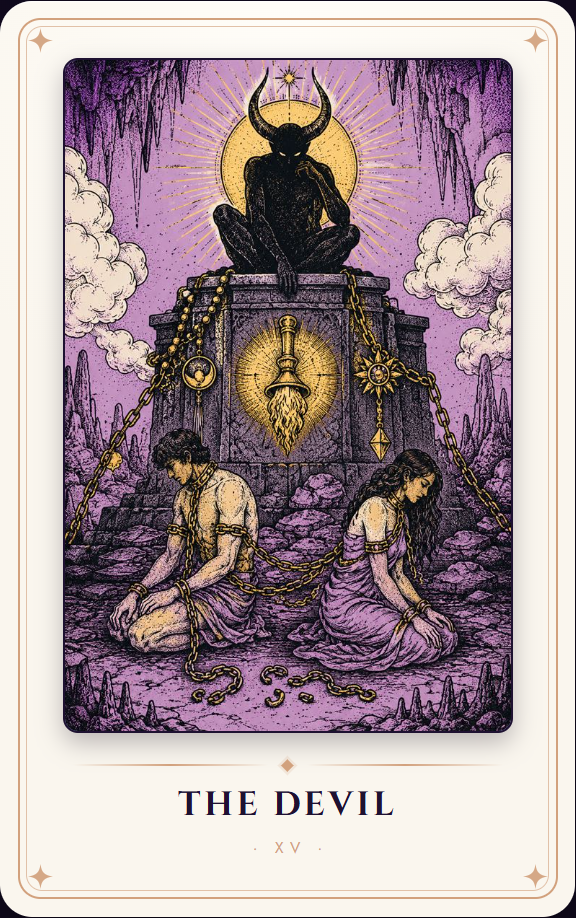
The Devil tarot card is not about evil.
What the Devil Card Means
There is no mystical evil in this card. The Devil in tarot means attachment: the habit that stopped serving you years ago, the relationship that hurts but is familiar, the small dependency or the large one, the fear wearing a costume that looks a lot like comfort. It is the deck's shadow card, standing in for the parts of yourself you would rather not examine, which is exactly why they get to run things from the dark.
The good news is hiding in plain sight, in the chains. What looks like a prison is actually an agreement, and every agreement can be renegotiated the moment you admit it exists. That is the whole card. Not freedom by Friday, not a dramatic renunciation of anything. Just the naming.
Most people who draw the Devil recognize it instantly and then argue with it for a minute or two. That reaction is information. The card does not arrive to inform you of something new; it arrives to say the thing you already suspected out loud, at a volume you can no longer talk over.
One thing worth stating plainly, since the imagery invites the opposite conclusion: this card is not a warning about someone cursing you, a spirit fastening itself to you, or bad luck heading your way. Tarot does not work like that, and Lunara does not read it that way. The Devil describes an internal arrangement, and an internal arrangement is the only kind you have any standing to renegotiate.
The Devil in Love and Relationships
In a love reading the Devil asks for brave honesty. It points to a bond held together by desire, habit, or fear of being alone more than by living affection. Consuming attraction sits on its territory too, because not every fire is a home. It also shows up in patterns: the same kind of person, the same ending, the same bruise in the same place. The card never says leave. It asks one sharp question instead. If the chain is loose, what is actually keeping you here?
An honest answer to that is worth ten readings. If you have been circling it for weeks, a single focused one-question reading will get you further than another evening of analysis. And when the Devil turns up beside the Lovers, the spread is almost always about the difference between choosing someone and being unable to stop.
The Devil in Career and Money
At work the Devil is the gilded cage: the salary that buys silence at the cost of a life, the role you stay in because moving feels dangerous, the culture everyone calls intense instead of toxic, the overwork that gets to call itself excellence. It also covers lopsided power. Dependence on one manager, one large client, one partner who quietly controls the terms — all of it is Devil territory, and all of it feels like loyalty from the inside.
In money questions the card is unusually literal. The statement you have not opened, the subscriptions that renewed themselves, the spending that soothes something it cannot actually fix. Its advice is unromantic and useful: write down the real price you are paying, in health, in hours, in self-respect, and then find the single link of the chain you could genuinely remove this month. One link. The Devil is broken by subtraction, not by willpower.
Curious what The Devil means for your own question?
The Devil Reversed
Reversed, the Devil is the release. The habit finally breaks, the dependency gets named out loud, the binding relationship ends, and you take the first step out of a cage that turns out to have been unlocked the whole time. It can also mark the moment just before, when the awareness has finished ripening and your hand is already on the chain. This is one of the most encouraging reversals in the deck, with one caveat it insists on: freedom needs maintenance, because the old cage will always leave the door open behind you.
Common Card Combinations
- The Devil + Strength: the way out runs through steady gentleness, not a war with yourself. Patience wins this one, not force.
- The Devil + The Tower: the chain snaps all at once. Liberation you did not schedule, shocking and freeing in the same breath.
- The Devil + The Lovers: the real choice, laid next to the compulsion. The pair exists to help you tell them apart.
- The Devil + The Star: what comes after the chain comes off. Recovery is slower than escape and matters more.