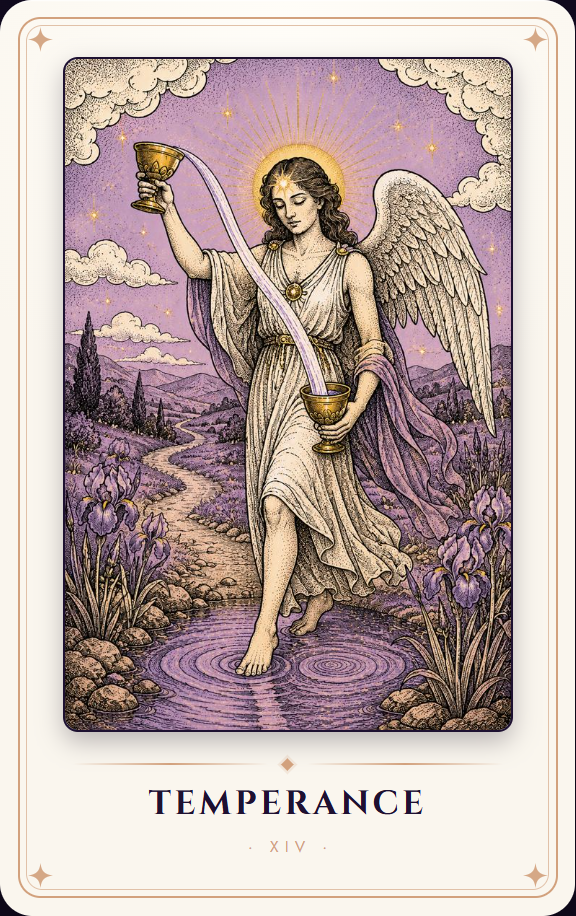
The Temperance tarot card means living balance, patience, and blending opposites — the deck's quiet alchemy.
What the Temperance Card Means
Temperance is the card of everyday alchemy: the ability to combine opposites — work and rest, closeness and space, the old life and the new one — and get a third thing out of them that is better than either. It is not a pale compromise, and it is not "somewhere in the middle." A good pour is an active, skilled act.
One foot in the water and one on the land: feeling and action at the same time, which is considerably harder than it sounds and is most of what the card is teaching.
The angel is pouring between two cups without looking down, and that detail is the whole point. This is skill that has turned into instinct, the mark of somebody who has done the mixing so many times that the proportion no longer needs calculating.
In a reading Temperance tends to arrive after extremes — a crisis, a big change, a sweeping enthusiasm — and proposes the hardest thing to do afterward, which is blending back into a workable routine with an artisan's patience. It is the least dramatic card in the deck and one of the most useful.
Temperance in Love and Relationships
In love readings this is the card of harmony that gets built rather than found: two different people learning, slowly and on purpose, to blend their differences — pace against pace, love language against love language — without either of them being erased in the process.
It is especially strong after a storm, marking real reconciliation, gradual repair, and trust rebuilt drop by drop rather than declared fixed in a single conversation. In a new relationship it recommends a small, long fire over a flame that consumes itself in a month, because the connections that blend slowly are the ones that hold. If what you're feeling is closer to compulsion than warmth, The Devil is the card that addresses it directly; Temperance is what becomes possible once that's been dealt with.
Temperance in Career and Money
At work Temperance is about sustainable pace: a project that advances consistently instead of in sprints and collapses, a real boundary between work and the rest of your life, the right combination of two occupations or of creative work and the thing that pays for it.
It is also the winning-team card, meaning the ability to blend very different people into a whole that functions. Its advice is simple and thoroughly unglamorous: take ten percent off the intensity, add ten percent to the consistency, and look at the results in six months. On money it favors steady accumulation and moderation over the big swing, which is boring counsel that happens to be correct.
Curious what Temperance means for your own question?
Temperance Reversed
Reversed Temperance is a lost sense of proportion: alternating extremes, all or nothing, a hundred-hour week followed by a week of collapse, suffocating closeness followed by disappearance. Or chronic impatience, trying to rush a process that requires slow cooking and will not be hurried.
It invites you to find where in your life the pour is spilling, and it is usually one specific place rather than everywhere, then to return to a small and precise motion. Nothing dramatic. The correction for a proportion problem is never another extreme. People who draw this one reversed are rarely lazy; they are usually over-poured in one direction and completely empty in another.
Why Temperance Follows Death in the Deck
Temperance comes right after Death in the Major Arcana, and reading them as a sequence explains both. Death clears; Temperance recombines. That is why Temperance so often surfaces six months to a year after a major loss or ending — it is the card of the rebuilding phase, when the drama is over and the actual work quietly starts.
Common Card Combinations
- Temperance + Death: the deck's original sequence. After the ending comes the gradual mending.
- Temperance + Strength: double patience. The healing or the achievement will arrive, at its own pace and not yours.
- Temperance + The Devil: correcting an extreme or a habit by dosage rather than by one dramatic blow.
- Temperance + The Star: deep recovery. Hope plus proportion, which is how healing actually holds.
- Temperance + The Sun: the slow blend pays out. Ordinary days start feeling good again.