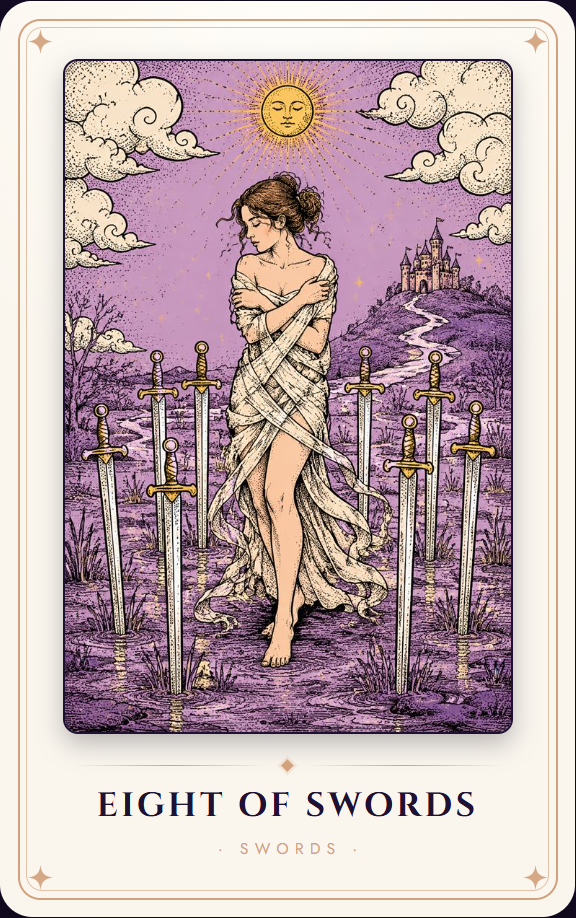
The Eight of Swords is a trap that lives mostly in your head.
What the Eight of Swords Means
This is the card of every sentence that begins "I have no choice." I have no choice but to stay. Nothing can change. This is just how it is. The card doesn't dismiss the feeling — from the inside, the trap is entirely convincing. It simply points at what's actually in the picture: the rope is loose, the eyes are covered but the feet are free, and eight swords make a fence, not a cage.
Most of the walls that hold us are built out of thoughts rather than metal. That sounds like bad news and isn't. Whatever was assembled in your head can be dismantled in your head, and usually faster than it took to build.
One more detail people miss: nobody tied her up. There is no jailer anywhere in the frame. Whatever put you here originally, the thing keeping you here now is a story you've been telling yourself about your options.
Eight of Swords in Love and Relationships
In a love reading this card describes stuckness with a narrative wrapped around it: "it's too late for me," "nobody will really love me," "I can't bring that up with him." Those are swords, not facts. Inside a relationship it appears when things feel like a trap and nobody has genuinely tried the door yet — one honest conversation, one clear request, one specific ask instead of another year of hinting.
Its advice is gentle and quietly radical: before you decide there's no way out, test the rope. It is looser than it looks. And if you're single, notice how many of your rules about dating were written by one bad year that you have since promoted to a law of physics.
Eight of Swords in Career and Money
At work this is the card of golden handcuffs and imaginary hurdles: staying in a role because "there are no options" without having actually checked in two years, a sense of financial dead end that has never once been put in front of a real advisor, an "I can't" that has never been tested.
Try the exercise the card is proposing. Write down the sentence that starts "I can't, because," then cross-examine every word in it like opposing counsel. Most of these sentences don't survive the questioning. The one or two clauses that do survive are your real constraints — and now you know what you're genuinely working with instead of what you assumed.
Curious what Eight of Swords means for your own question?
Eight of Swords Reversed
Reversed, the Eight of Swords is the moment of release. The blindfold comes off, the old story suddenly sounds absurd said out loud, and the feet start moving. It usually arrives with outside help — a friend, a therapist, a conversation that breaks the loop — because that is how thought-traps generally end. Almost nobody argues their way out of one alone.
If it turns up while you still feel stuck, read it as the invitation rather than the report: this time, the door really is open.
How to Get Out of a Trap in Your Own Head
- Say it out loud to someone. Limiting thoughts survive best in the dark. Spoken to a person you trust, the rope loosens on its own.
- Separate the fact from the story. Write the constraint in one column and everything you've built around it in the other. The fact is usually about a third of the trap.
- Take one small, real step. Send the email, book the call, ask the question. Motion breaks the spell faster than insight does.
- Check when you last tested it. Plenty of closed doors were last tried years ago, by a version of you with different options.
Common Eight of Swords Combinations
- Eight of Swords + The Devil: the trap runs deeper — a habit or a dependency with real grip. Even there, The Devil draws the chains hanging loose.
- Eight of Swords + The Star: hope dismantles the prison, and the light at the end turns out to be genuine.
- Eight of Swords + The Fool: the first step out, and the discovery that you could have taken it the whole time.
- Eight of Swords + Nine of Swords: the trap and the 3am worry feeding each other. Handle the sleep first — the Nine is the louder of the two.