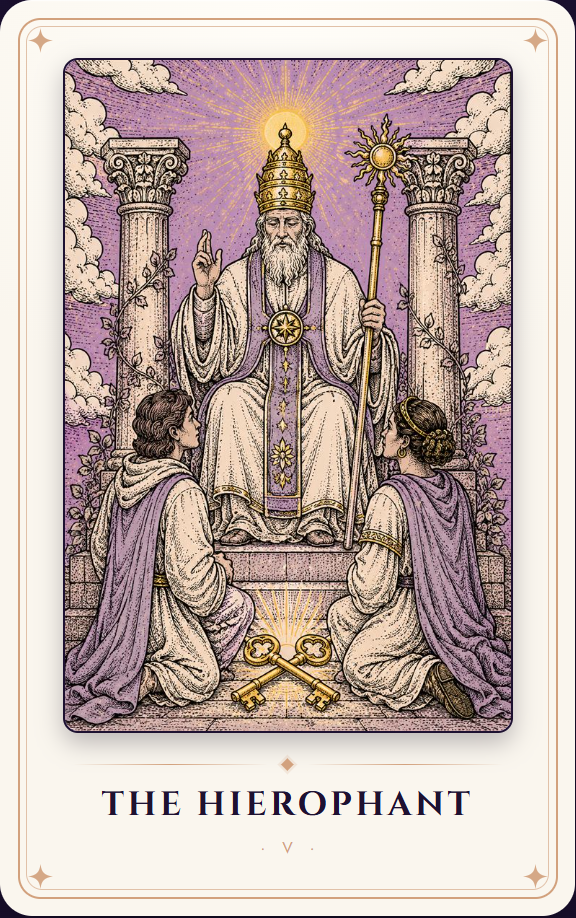
The Hierophant tarot card meaning: tradition, teachers, and the road someone already walked.
What the Hierophant Card Means
The Hierophant represents institutional wisdom: tradition, structured learning, teachers, community, ritual. He is the recognition that not every path needs to be cut by hand. Some roads have been walked by thousands of people, and there is enormous value in learning from somebody who has already made the trip.
In a reading he appears around study, professional training, the search for a mentor, joining a community, and questions of faith and inherited belief. He is also the card of ritual in the broad sense: a wedding, a standing dinner every Friday, a weekly class, the frames that give a life weight and rhythm. He is the most conservative card in the deck and he knows it. His job is not to be exciting. His job is to be reliable.
The Hierophant in Love and Relationships
In love readings this is the most traditional card there is: formalizing a relationship, marriage, meeting the families, a couple moving through recognized steps in a recognized order. Usually that is good news, because there is real security in familiar footing, and the Hierophant is at his best when the conventional path happens to also be the right one.
He also turns up when a relationship collides with questions of background and tradition, whether that is religion, culture, or the quiet weight of what people will say. His invitation is to sort one from the other: which parts of the tradition are values you genuinely hold, and which are habits you inherited without ever inspecting them. That distinction is the entire reason this card exists. Read beside the Lovers the tension becomes explicit, since one card is the road of the heart and the other is the road that is approved.
The Hierophant in Career and Money
His professional message is double. Learn from professionals: a real course, a credential, an actual mentor. And do not dismiss the rules of your field before you have demonstrated that you know them. He shows up for people weighing a career change that requires proper training, for people who need apprenticeship rather than another video, and inside organizations around procedure, hierarchy, and culture. That last territory he shares with the Emperor, though the Emperor governs the rules and the Hierophant governs the meaning underneath them.
Real innovation, he would remind you, comes from people who know the tradition well enough to know exactly where to break it. On money he favors the conventional and the unglamorous: established institutions, standard advice, the pension nobody enjoys thinking about.
Curious what The Hierophant means for your own question?
The Hierophant in Questions of Faith and Belief
When a question touches belief, the Hierophant is usually the card that answers it. He does not tell you what to believe. He describes your relationship with an inherited framework and asks whether you are inside it, outside it, or standing in the doorway pretending not to have noticed the door.
For people returning to a practice they left, he is affirming. For people questioning one they were raised inside, he is not a rebuke, and the reversed card is where the deck gives its blessing to leaving. He learns in company, which is what separates him from the Hermit, who learns alone. Most people need both, in different seasons.
The Hierophant Reversed
The reversed Hierophant is tradition that has lost its soul: rules performed without anyone remembering why, an institution demanding obedience instead of offering meaning, a "that is how it is done" that blocks the right road. He covers bad teachers, dogma, and organizations that mistake procedure for purpose.
He is also the card of healthy rebellion, the moment when leaving the paved path is genuinely correct. The question he poses is sharp, and it cuts both ways. Are you leaving the tradition because you examined it, or because examining it would be inconvenient?
Common Card Combinations
- The Hierophant + The Lovers: a relationship moving toward formal commitment, or a choice between the road of the heart and the accepted one.
- The Hierophant + The Hermit: two kinds of knowledge, the taught and the inner. Time to combine them.
- The Hierophant + The Fool: the classic tension, the paved road against the private trail.
- The Hierophant + The Emperor: institution and structure moving together. A season for paperwork, titles, and official steps.